
Best Agentic Revenue Enablement Platforms: An Enterprise Evaluation Framework
Oct 22, 2026
Picture the third vendor demo of the week. The rep clicks a button labelled "Agent," a chat window opens, and a very polished assistant answers a question about your pricing deck. Everyone nods. Then someone on your team asks the question that actually matters: can it send the follow-up, update the CRM and flag the stalled deal without a human clicking anything? The room gets quiet.
That quiet is the problem this guide is built to solve. Shortlisting the best agentic revenue enablement platforms is hard because every vendor now uses the word "agentic," and almost none of them define it the same way. Below you will find a simple definition, a readiness check, a six-criteria scorecard you can reuse in any demo, a neutral look at where the major vendors stand, and a pilot plan that keeps the decision honest. Read it before your next revenue enablement vendor call, and you will ask better questions than the vendor expects.
What "agentic" actually means in revenue enablement
An agentic revenue enablement platform uses AI agents that plan and finish tasks for sellers, such as prepping calls, recommending content, coaching reps and drafting follow-ups, instead of only suggesting them. The best ones act inside your CRM and content stack, stay within governance rules, and show measurable impact on pipeline.
Agentic AI in revenue enablement means software that understands a goal, plans the steps, takes action inside a seller's workflow and adjusts based on what happens next. A chatbot answers a question. An agent answers the question, then does the next three things the answer implies, and tells you what it did.
That distinction is now the center of how analysts talk about the category. An agentic revenue organization as one where sellers stay accountable for outcomes while AI agents carry more of the execution. Forrester's read on the market is that platforms are shifting from recommending actions to taking them, which includes drafting emails, assembling content for a specific buyer and surfacing deal insights from signals across the stack. Gartner published its first Magic Quadrant for Revenue Enablement Platforms in November 2025, and according to a vendor summary of that report, it expects agentic AI to automate roughly 70% of routine enablement work (playbook upkeep, battlecard curation, content library management, training scheduling) by 2030. Treat that number as a direction of travel, not a promise, since it reaches us through a press release. It does tell you what your team's job will look like: less upkeep, more judgment about what the agents should do.
Before you shop: are you ready for agents?
The most common way to waste a platform budget is to buy capability your organization cannot feed. Forrester's finding is blunt on this point: organizational readiness, not product functionality, is the top barrier, and teams that skip the groundwork fall into what it calls the "shiny platform trap," switching vendors in search of a fix that was never about the vendor.
Most AI Agents in market are only as good as what they can read and what they are allowed to touch. Run this pre-flight check with your RevOps and marketing counterparts before the first demo:
- CRM hygiene: are deal stages, owners and close dates trustworthy enough for an agent to act on them?
- Content governance: do you know which assets are approved, current and allowed in each region, or does a rep still find three versions of the same deck?
- Ownership: who will configure, monitor and correct agents after launch? Enablement teams are often small, and AI does not shrink the workload so much as change it.
- Success definition: what will you measure at 90 days, and who agrees it counts?
No platform fixes a missing owner for you. A clear process is the cheapest upgrade available, and your revenue enablement processes are the place to start before you spend a dollar on software.
The six-criteria evaluation framework
A useful scorecard turns vendor language into things you can watch happen. Score each criterion from 0 to 2 in the demo: 0 for slideware, 1 for works with manual steps, 2 for works unattended with controls. A platform that lands at 9 or more out of 12 is worth a pilot.
1. Autonomy and human override. Ask for a live example of an agent finishing a task from trigger to outcome. Then ask where a person can step in. Good platforms separate low-risk actions an agent can take on its own (surfacing a brief) from higher-risk ones that need approval (sending a message to a buyer). Weak ones treat every action as either fully manual or fully automatic.
2. Data and signal depth. An agent is a reader first. Check which signals it uses: CRM fields, buyer engagement with content, call transcripts, deal stage and rep skill data. The more of these it combines, the less generic its recommendations will feel.
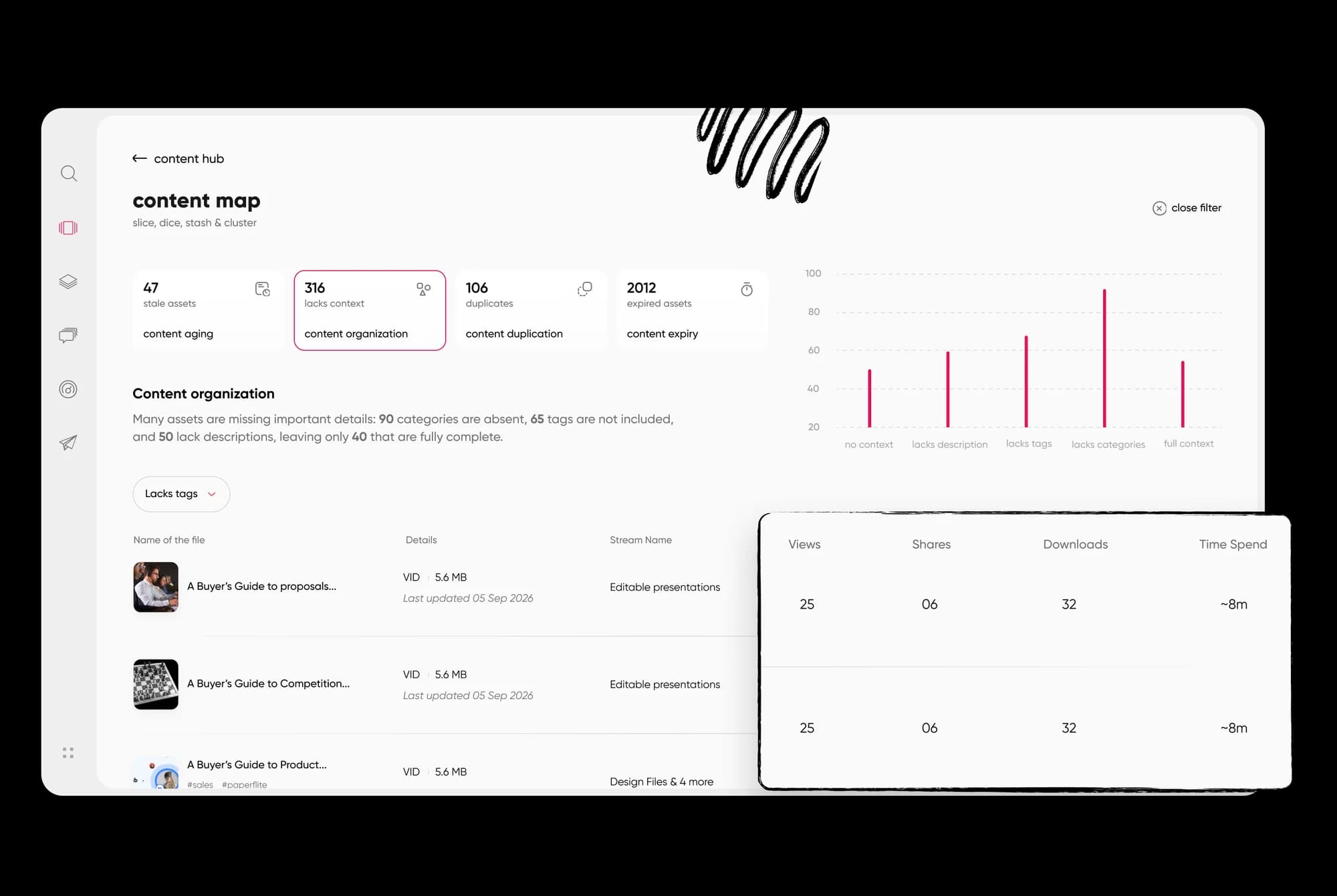
Adoption and usage analytics show whether agents and content are actually being used across the team.
3. Workflow coverage. Map the platform against the moments that matter to your sellers: pre-call prep, finding the right content, practice and coaching, follow-up and buyer collaboration in a deal room. One platform rarely wins everywhere, so decide which two or three workflows carry your revenue and weight them.
4. Governance and brand safety. Agents should draw from approved content only, respect permissions by role and region, and leave an audit trail. Ask what happens when an agent is wrong, how errors are reported, and who can switch an agent off.
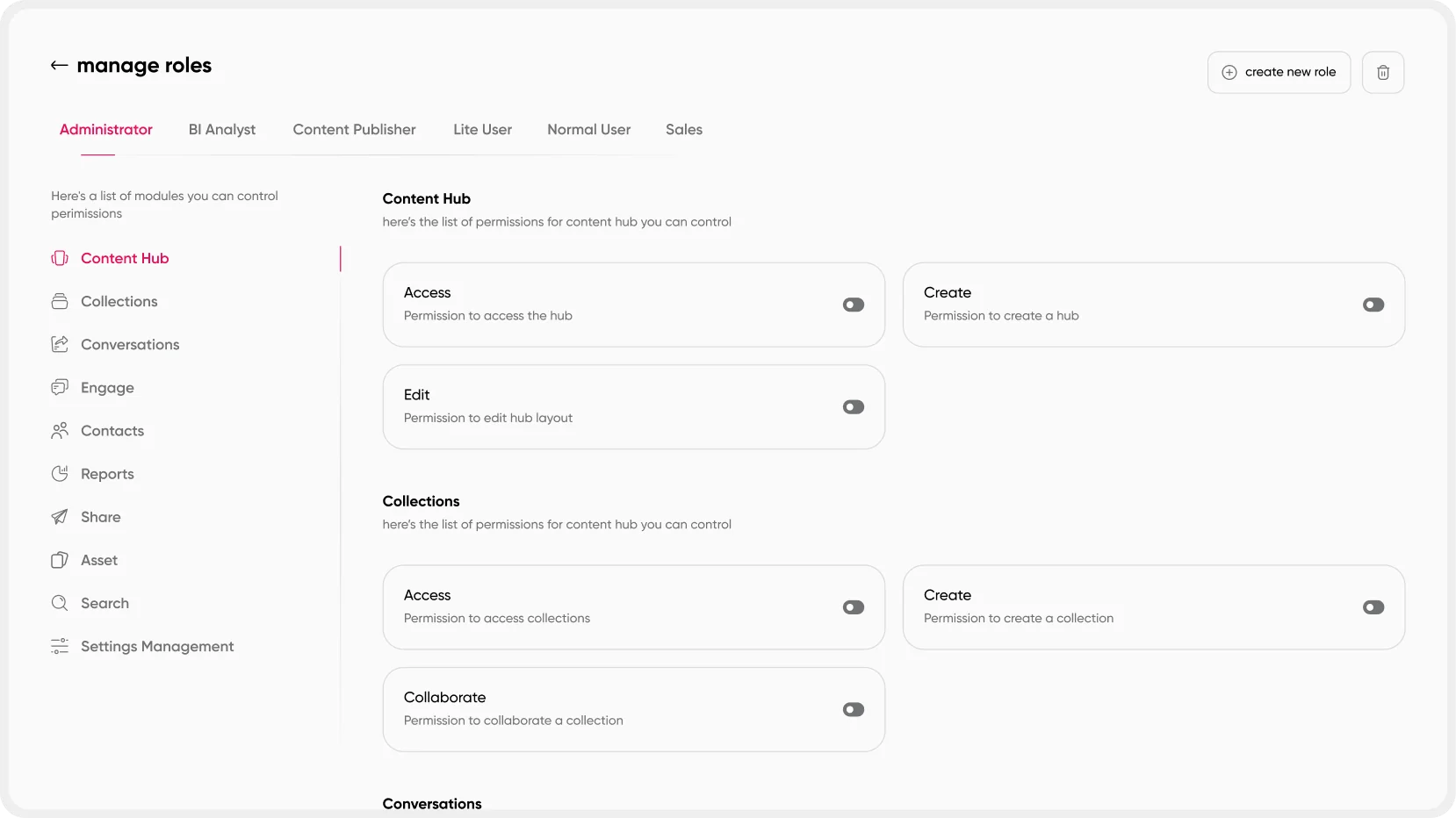
Role-based permissions decide what each user, and each agent acting for them, is allowed to see and share.
5. Integration depth. Check for two-way CRM sync rather than one-way display, calendar and conferencing hooks, and an open way for outside agents and tools to connect. Several vendors now advertise support for the Model Context Protocol, which is worth asking about directly because it determines whether the platform plays well with the AI tools your company already runs.
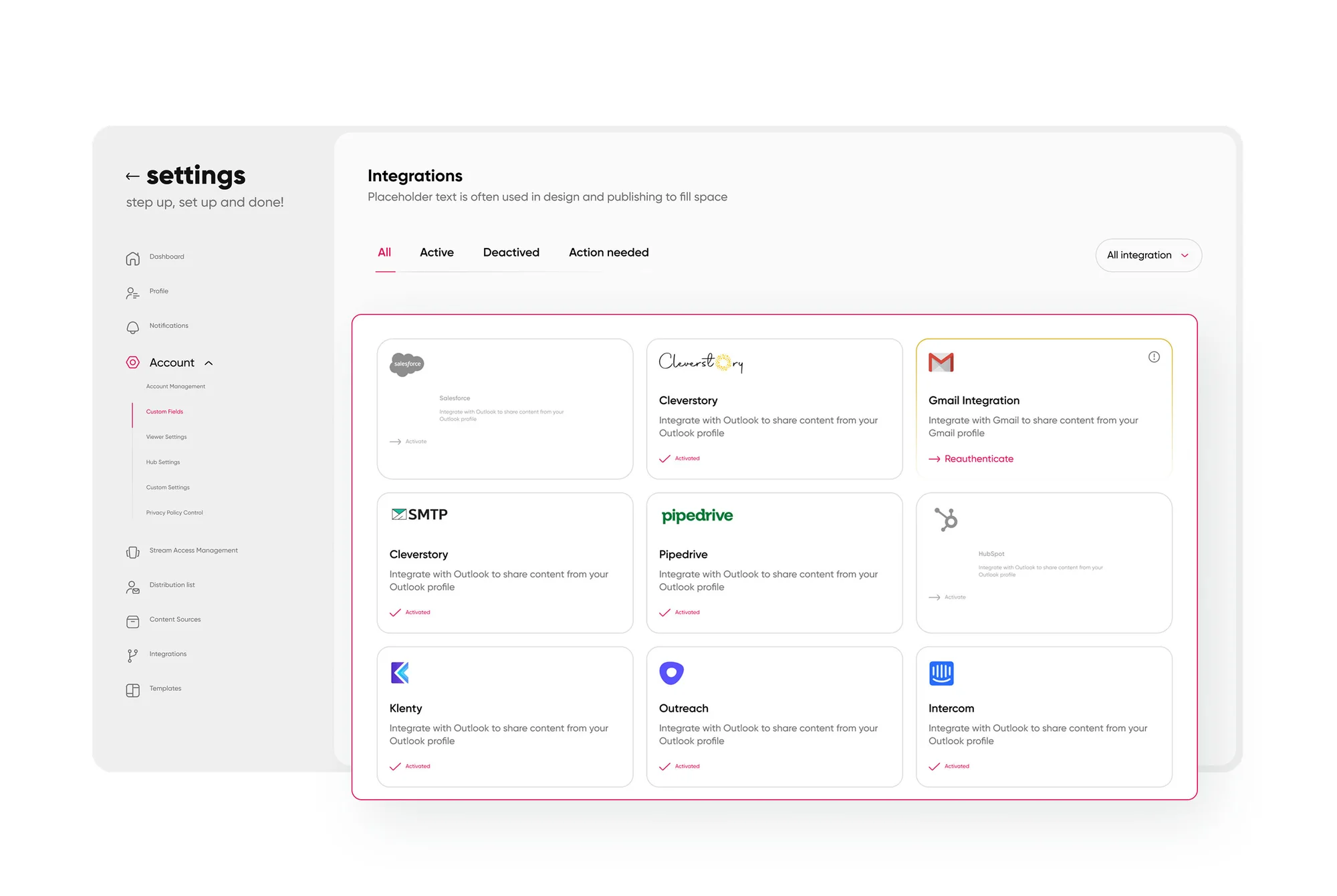
An integrations hub shows which systems feed the platform and which it writes back to.
6. Proof and total cost. Ask for time to value from comparable customers, the adoption analytics you will get, and how pricing changes as you add agents or modules. Hidden cost usually lives in services, add-on modules and the internal hours needed to maintain content and prompts.
Weigh the criteria to match your situation. A regulated enterprise should double-count governance. A fast-scaling team with a thin enablement function might double-count time to value.
How the leading platforms stack up on agentic capability
Highspot. Its Winter Launch 2026 introduced a Deal Agent that combines CRM data, buyer engagement and meeting insights into a live view of each deal, then suggests next steps such as flagging risk, starting a deal-specific AI role play or creating a digital sales room. Skills frameworks and AI-powered assessments sit alongside it, all running on a shared AI and analytics layer the company calls Nexus. On the scorecard, that is strong on data depth and workflow coverage. Highspot was also named a Leader in the 2025 Gartner Magic Quadrant, with the highest placement for Ability to Execute, according to its own announcement.
Seismic. Its Aura agents are grouped by job: enablement teams get Analytics, Program, Page, Lesson and Admin agents, while sellers get Meeting, Presentation, Roleplay and Search agents, plus a conversational Aura Chat workspace. The company's explainer content frames the category as human-led and AI-supported. Expect depth in content and presentation workflows. Ask what each agent does without a prompt, since public descriptions stay general.
Mindtickle. ElevateOS, launched in April 2026, positions itself as an agentic operating system built around readiness. It bundles a Behavior Intelligence layer that links rep behaviors to won and lost deals with agents for tutoring, role play, manager coaching, content creation and deal guidance, plus AI-orchestrated digital sales rooms. It is built on the MCP and A2A protocols so outside agents can connect, and you can start with one capability such as AI role play. That is a strong fit if your main gap is rep readiness.
Showpad. The Summer '26 release brought Genie Agents (six prebuilt, with an Agent Studio for custom ones), an MCP server with prebuilt links to Salesforce Agentforce, Microsoft Copilot and Glean, a Field Seller Agent for pre-meeting briefs and CRM sync, and role play with feedback in more than 35 languages. It stands out on integration breadth and field-seller workflows.
SalesHood. Has concentrated on AI-assisted digital sales rooms: call summaries from Zoom and Gong, mutual action plan templates, buyer-specific pages and deeper HubSpot connections. Its customer claims on pipeline and win rates are self-reported, so ask for references in your segment.
Where pf1 fits
pf1 is organized around a single idea: one shared base of company knowledge and buyer behavior, with six agents working from it. Lead, Experience, Knowledge, Distribution, Deal and Coaching each own a motion, and none of them starts from zero.
What one agent learns, the others can use.
pf1 puts six agents (Lead, Experience, Knowledge, Distribution, Deal and Coaching) on one shared base of company knowledge and buyer behavior. The case for it rests on what happens when content, deals and coaching learn from each other, which is the combination most standalone tools have to stitch together.
On deals, sellers can ask the Deal agent questions in context and open a pre-call briefing before a meeting, so prep does not depend on someone remembering to assemble it. A seller asks the Deal agent a question without leaving the deal record.
A pre-call briefing pulls deal context into one view before the meeting.
After the call, an AI-drafted follow-up email and nudges toward the next move cover the step where momentum usually leaks.
Managers get the same layer in a different shape: they can query the pipeline in natural language and triage at-risk deals without waiting for a rep to update a spreadsheet. An AI-drafted follow-up email is ready for the seller to review and send.
Managers see which deals need attention first, without chasing reps for updates. Content stays the foundation.
The Knowledge agent keeps approved material in one governed source, an AI assistant in the content hub answers questions from it, and buyer-facing deal rooms come with an AI summary, so what a seller shares is what marketing signed off on. If your team’s pain is a messy library, the sales content management guide covers the groundwork, and Distribution’s asset-level analytics show which content is actually moving deals.
The content hub assistant answers questions from approved assets. A deal room overview with an AI summary of buyer activity. The Coaching agent covers the practice side with persona-based role play that scores each attempt, which is where readiness gaps show up before a real buyer finds them. For a wider view of coaching software, see these sales coaching tools.
A role play attempt is broken down and scored so coaches see where reps struggle. On the scorecard, pf1 is strongest on knowledge and engagement data, workflow coverage across deal prep, follow-up and coaching, and hands-on implementation from a forward-deployed team.
The best part, get to see all of this with your exisiting content and setup - book a demo
Questions to ask in every vendor demo
Use the same script with every vendor so scores stay comparable. These seven questions expose the gap between demo and deployment quickly:
- Show me an agent finishing a task from trigger to outcome without a human click. Which step needed approval, and why?
- Which data does the agent read to make this recommendation, and can I see that source?
- What happens when the agent is wrong, and how would my team find out?
- Who in my organization configures and monitors agents, and how many hours a week does that take at steady state?
- Can the agent only use approved content, and can I prove it with an audit trail?
- Which of your agents are generally available today, and which are on the roadmap?
- Can I start with one workflow, and what does pricing look like when I add a second?
Running a pilot and measuring ROI
A pilot should be small enough to finish and specific enough to settle the decision. Pick two finalists, one use case that matters to revenue and a window of 60 to 90 days. Good starting use cases are pre-call prep for a single segment or role play for new-hire ramp, because both produce visible results quickly.
Agree on the numbers before you begin. Time to ramp for new reps, content usage in live deals, deal progression between stages and manager time spent on inspection are all measurable in a quarter. Adoption comes first, since an agent nobody opens proves nothing, and the full set of revenue enablement KPIs gives you a longer menu to choose from. Write the success threshold down, share it with both vendors and review results together at the end.
The short version
The best agentic revenue enablement platform for you is the one that scores well on the six criteria for your highest-value workflows, fits your data and governance reality, and proves itself in a pilot you designed. Vendor claims will keep changing. A scorecard and a demo script will not.
Curious how pf1 holds up against these six criteria on your own deals? Talk to sales and bring your hardest demo questions.
Frequently asked questions
What is an agentic revenue enablement platform?
It is an enablement platform where AI agents complete tasks for sellers and managers instead of only offering suggestions. Typical tasks include preparing a call brief, recommending the right content, running role play, drafting a follow-up and flagging at-risk deals. The agents work inside your CRM and content stack under permissions you control.
How is agentic AI different from an AI assistant or copilot?
An assistant responds when you ask. An agent pursues a goal across several steps, takes action in connected systems and reports back. The practical test is whether it can finish a task end to end with a clear approval point for risky actions, or whether a person has to carry each step forward.
Will agentic AI replace sales enablement teams or sellers?
Current vendor and analyst framing points to AI taking over routine work such as content upkeep, scheduling and first drafts, while people keep accountability for outcomes and for deciding what agents should do. Enablement teams shift toward configuring agents, checking quality and measuring results, so the job changes rather than disappears.
What should enterprises ask vendors about AI governance?
Ask which content agents may use, how permissions follow roles and regions, whether every agent action is logged, and who can pause an agent. Also ask what happens when an agent produces a wrong or off-brand output, and how your team is alerted. Good answers are specific and demonstrable in the product.
How long does it take to see results from an agentic platform?
Adoption and workflow results such as faster call prep or follow-up usually show within 60 to 90 days of a focused pilot. Revenue outcomes like win rate or cycle length take longer, often a full quarter or more, because deals need time to move. Set expectations by metric, not with a single date.
Revenue enablement versus sales enablement: which platform do I need?
Sales enablement focuses on sellers. Revenue enablement extends the same support to customer success, marketing and sometimes partners, so the whole revenue team works from one source of content and coaching. Read the breakdown of revenue enablement vs sales enablement if you are deciding scope.
How do I compare platforms without a long RFP?
Use one demo script and one scorecard for every vendor, then pilot two finalists on a single use case with agreed metrics. The six criteria in this guide give you a short, repeatable method, and a 60 to 90 day pilot gives you evidence an RFP spreadsheet cannot.
Paperflite's Content Technologyin Action
It's Easier Than Falling Off a Log
(Don't Ask Us How We Know That)

