Dock Alternatives (2026): 5 Sales Room Tools Compared
Nov 24, 2026
Dock isn't just a deal room anymore
In 2026 alone, Dock added slides, courses, an AI agent builder, an MCP server for Claude and ChatGPT, an API, and on November 9, AI tutors and roleplay. So most teams looking for a Dock alternative now want one of two things: a sharper deal room, or more of the revenue motion on one platform.
The short answer: pf1 suits teams that want deal rooms connected to pipeline, coaching and deal insight. Trumpet suits buying-committee rooms, Aligned the cheapest paid seat, Flowla a free start, and GetAccept signing inside the room.
pf1 (from the house of Paperflite) publishes this guide, and our Deal agent is one of the tools listed. We put ourselves first because it's our blog; every tool, including ours, is judged on the same criteria.
Quick picks (pricing as of November 2026)
| Tool | Best for | Starts at |
|---|---|---|
| Dock | Revenue teams that want deal rooms, onboarding portals, content and training in one workspace | Free plan; Standard $350 a month for 5 users |
| pf1 | Teams that want deal rooms connected to the rest of the revenue motion: AI agents that bring in pipeline with personalized pages, then build deal-specific decks, proposals and deal rooms from what has won before | Free migration from Dock. Custom pricing; contact pf1 for a quote |
| Trumpet | Sellers working big buying committees who want rich, branded sales rooms | Free plan (10 Pods); Pro $45 per user a month |
| Aligned | Small teams that want mutual action plans and rooms at the lowest paid seat price | Free plan; Basic $29 per seat a month, billed annually |
| Flowla | Teams testing deal rooms before committing budget | Free plan (20 rooms); Team $99 per seat a month |
| GetAccept | Teams that need e-signature and pricing tables inside the deal room | Professional $49 per user a month, 5-user minimum |
What Dock does well
Dock calls itself revenue enablement software: AI that creates buyer workspaces, finds sales content, trains teams and powers agents. Here's what that covers today, per Dock's product pages and release notes (Nov 2026).
- Rooms for the whole customer journey. Deal rooms, onboarding hubs and client portals share one workspace, so a buyer sees the same space from first call to go-live. Buyers never need a Dock account.
- Deals close inside the room. Order forms pull products and CRM data into a quote, and buyers sign in Dock through an embedded Dropbox Sign flow.
- AI that builds, not just finds. Dock AI creates deal rooms, onboarding hubs, playbooks and courses from templates, call transcripts and CRM data. Buyers can ask the room questions through Buyer AI Chat.
- Training in the same place. Courses and playbooks arrived earlier in 2026; on November 9, Dock added learning pathways, AI tutors and AI roleplay.
- It works where reps already are. An MCP server lets teams create rooms and run Dock agents from Claude or ChatGPT, and an API arrived in October 2026.
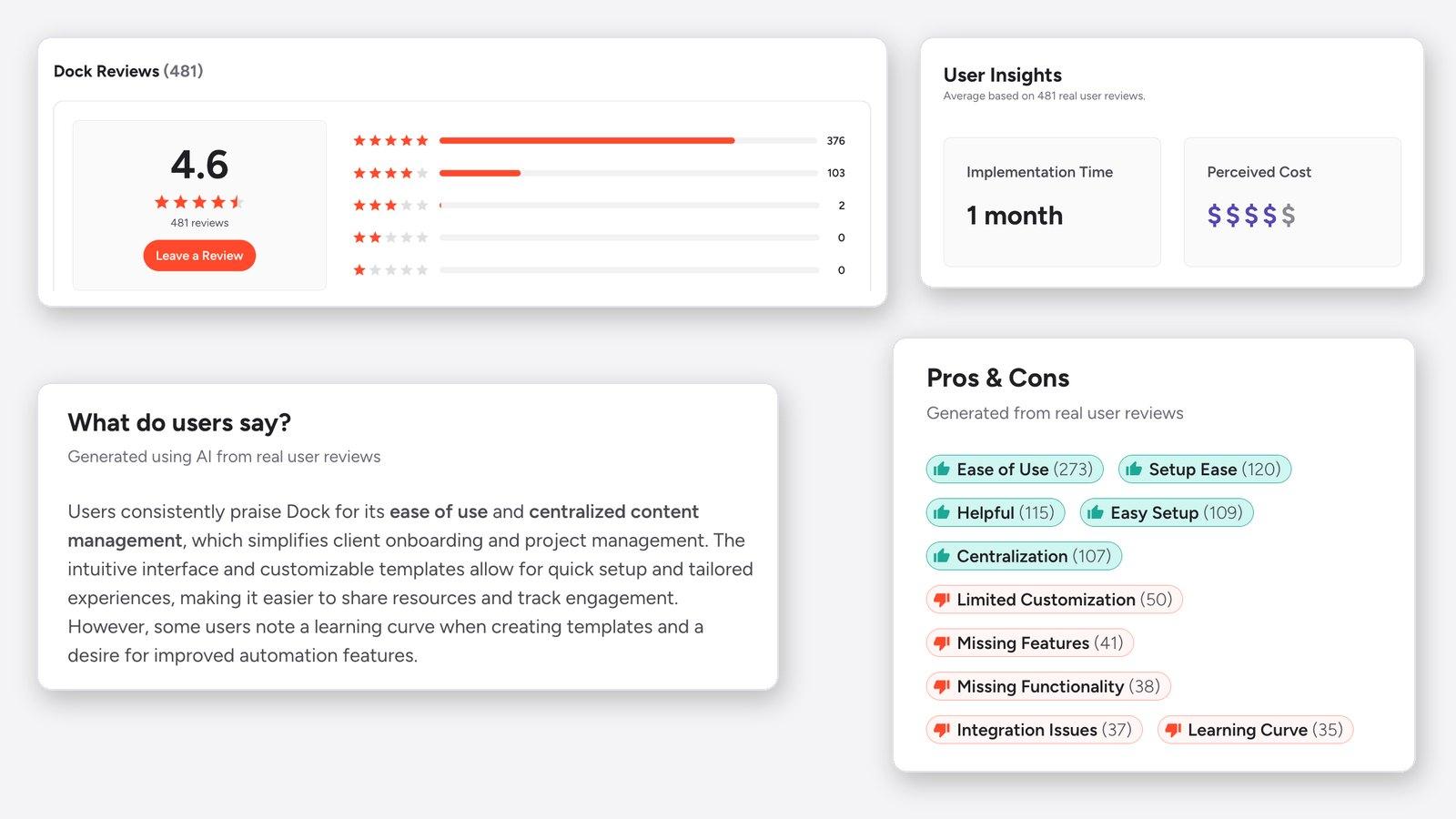
Users rate it highly. Dock holds 4.6 out of 5 on G2 from 481 reviews, with ease of use (273 mentions) and setup ease (120) the top themes, and G2 users put implementation at about a month.
Why teams still shop around
The reasons come from Dock's own G2 reviewers and its pricing page.
- Branding has a ceiling. "Limited customization" is the most common con on G2, in 50 reviews, and reviewers ask for more control over fonts and layouts. Removing the Dock logo needs Premium; a custom domain needs Enterprise.
- Some features aren't there yet. "Missing features" (41 reviews), "missing functionality" (38) and "integration issues" (37) are the next most common complaints.
- The price steps up fast. Free covers 10 workspaces. Standard is $350 a month for five users, learning needs Premium at $1,000 a month billed annually, and SSO and the API need Enterprise, from 25 seats.
- Templates take work. 35 reviews mention a learning curve, and G2's summary ties it to building templates, along with requests for more automation.
- It starts at the deal. Dock's rooms begin once a seller is talking to a buyer. Bringing in that pipeline, from personalized marketing pages to spotting which companies visit your site, sits in other tools.
How we judged them
We scored every tool, including ours, on six criteria:
- The room itself: branding, mutual action plans, stakeholder mapping and buyer analytics.
- What AI builds: rooms, documents and follow-up from CRM data and calls.
- Closing: quotes, pricing tables and e-signature inside the room.
- Beyond the deal: pipeline before the room, coaching and onboarding after it.
- Cost: free plans, seat minimums and what five sellers pay a year.
- Governance: approved content, SSO and audit trails.
What we checked. We read each tool's product pages, help docs, pricing pages and release notes, G2 and Capterra reviews, and dated coverage, in November 2026. Our team has used several of these tools firsthand and sat in on many of these vendors' sales calls, so we know how they sell, price and plan their roadmaps.
The 5 best Dock alternatives in 2026
1. pf1 (from the house of Paperflite): for deal rooms connected to pipeline, coaching and deal insight
What it is. pf1 is an agentic growth team for sales and marketing: AI agents that work from your approved company knowledge and learn from what buyers do. For a Dock team, the room stops being the start. pf1 brings in the pipeline, then builds the deal-specific decks, proposals and deal rooms that close it.
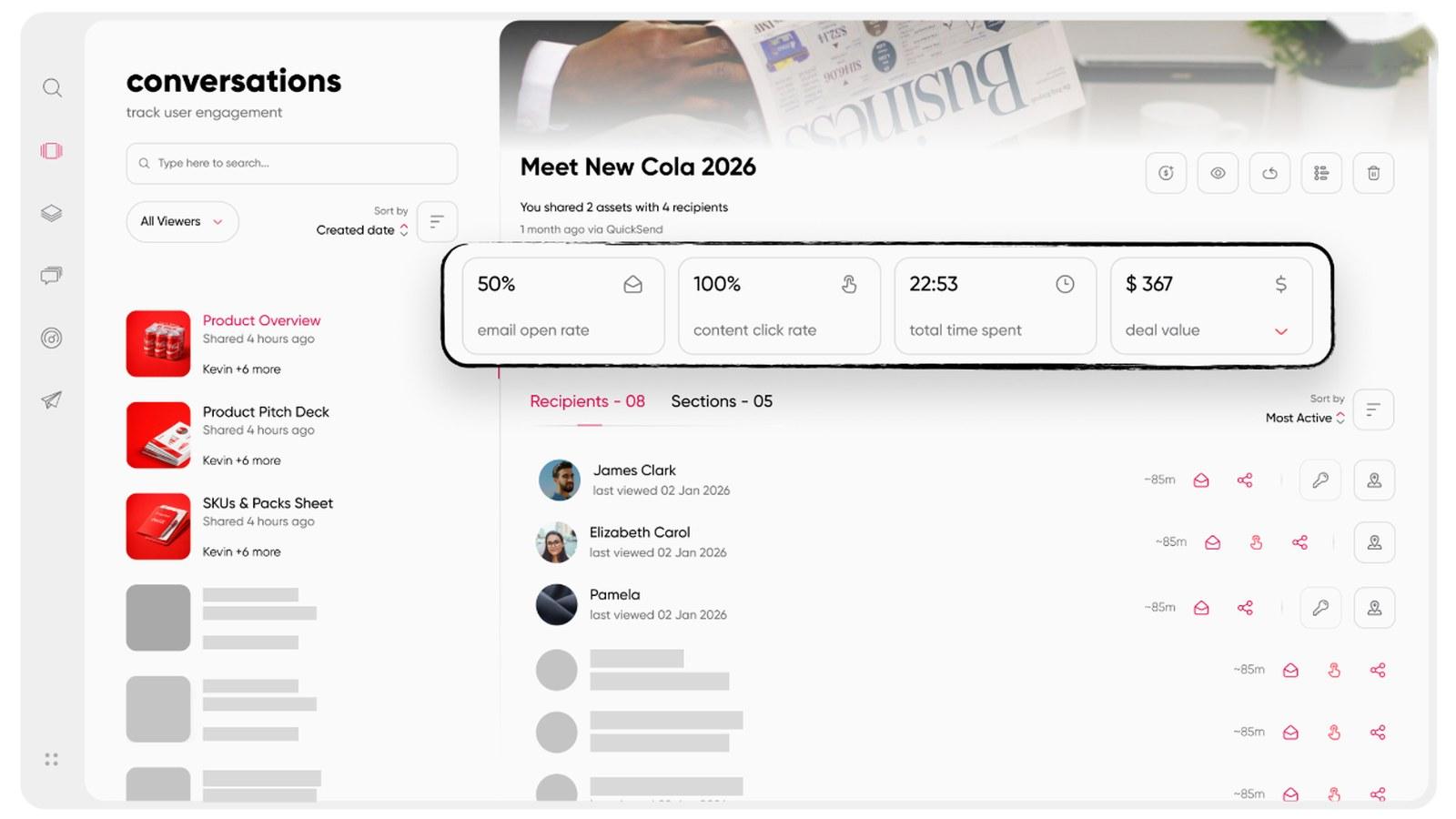
The Deal agent builds deal rooms, decks and proposals from CRM data and content that has won before, and scores deal health. The Lead agent and Experience agent turn approved content into personalized pages that bring buyers in. The Coaching agent runs AI roleplays from your own deals.
Both products talk about agents. Dock's agents help reps build rooms and find answers; pf1's agents also bring in the pipeline and learn from which content wins. Customers named on pf1.ai include ServiceNow, e2open, HP and CBRE, with approval gates, audit trails, SSO and SOC 2 Type 2 behind it.
What it does that Dock doesn't:
- Company-level identification of website visitors, with assets gated by intent (Lead agent)
- Personalized marketing assets and pages that bring in pipeline before a room exists (Experience agent)
- Deal health scored against your own won and lost deals (Deal agent)
- New assets for reps generated from content performance and deal outcomes, so one rep's win becomes a pattern the whole team repeats
- Employee advocacy, so reps share approved content on social
In practice. Freshworks cut its cost per lead by 70% and lifted returning visitors by 26% with a campaign hub, per pf1.ai (Freshworks story). It was built on Cleverstory, which now runs inside pf1 as the Experience agent and the Lead agent.
Watch-outs. pf1 has no free or self-serve plan. It's built for teams, not individuals, and it's strongest when your content and CRM deal data are connected to it.
Pricing. Free migration from Dock. Custom pricing; contact pf1 for a quote.
Best for. Teams that want deal rooms connected to the rest of the revenue motion: AI agents that bring in pipeline with personalized pages, then build deal-specific decks, proposals and deal rooms from what has won before.
2. Trumpet: for rooms built around the buying committee
What it is. Trumpet is a digital sales room built around "Pods": branded buyer spaces with mutual action plans, content and analytics. Trumpet says it ranked as G2's top digital sales room globally in Winter 2026.
What it does that Dock doesn't:
- An AI engagement score for every Pod, from the Pro plan
- AI-recommended stakeholders on the Scale and Elite plans, to widen the buying group
Watch-outs. Pro is capped at five users, and e-signature, proposals and Trumpet AI start on Scale, per Trumpet's pricing page (Nov 2026). Some Elite AI features are marked as coming soon.
Pricing. Free for 10 Pods with unlimited users. Pro is $45 per user a month ($450 a year), Scale $100 ($1,000 a year) and Elite $160 ($1,600 a year).
Best for. Sellers working big buying committees who want rich, branded sales rooms.
3. Aligned: for mutual action plans on a small budget
What it is. Aligned is a deal room built around the mutual action plan, with a stakeholder map, content and room analytics. It raised a $60 million Series B in July 2026.
What it does that Dock doesn't:
- Pricing per seat, so a team of two pays for two, not a five-user bundle
- A stakeholder map, surveys and forms on the free plan
Watch-outs. The free plan allows four active rooms per seat, AI starts on Pro, and full two-way Salesforce and HubSpot sync needs Enterprise, per Aligned's pricing page (Nov 2026). Aligned focuses on the sale, not training.
Pricing. Free plan; Basic $29 and Pro $49 per seat a month, billed annually ($35 and $60 monthly). Enterprise by quote.
Best for. Small teams that want mutual action plans and rooms at the lowest paid seat price.
4. Flowla: for a free start with deal rooms
What it is. Flowla is a digital sales room for deal rooms, mutual action plans and onboarding, with an AI agent called REX that drafts rooms and documents.
What it does that Dock doesn't:
- A free plan with up to 20 rooms, twice Dock's free workspace limit
- Month-to-month Team billing with no seat minimum
Watch-outs. The free plan has no e-signature or team reporting, and SSO and custom domains need Enterprise, per Flowla's pricing page (Nov 2026). Flowla is built for rooms, not rep training.
Pricing. Free Starter plan; Team $99 per seat a month, billed monthly. Enterprise by quote.
Best for. Teams testing deal rooms before committing budget.
5. GetAccept: for signing and pricing inside the room
What it is. GetAccept combines e-signature, proposals and digital sales rooms, with pricing tables, video and AI for drafting content.
What it does that Dock doesn't:
- Native Microsoft Dynamics 365 and other premium CRM integrations, on Enterprise
- Contract management alongside e-signature, from the entry eSign plan
Watch-outs. Deal rooms start on Professional, with a five-user minimum, and every plan runs on a 12-month agreement, per GetAccept's pricing page (Nov 2026). CPQ and Salesforce need Enterprise.
Pricing. eSign $25 per user a month (no deal rooms); Professional $49 per user a month, billed annually. Enterprise by quote.
Best for. Teams that need e-signature and pricing tables inside the deal room.
How Dock and the alternatives compare
Start with cost, because it's where these tools differ most. Then the two capability tables show what they share and where they split.
What five sellers pay a year (list prices, Nov 2026)
| Tool | Plan with deal rooms | Five sellers a year | Worth knowing |
|---|---|---|---|
| Dock | Standard, billed monthly | $4,200 | Learning needs Premium: $12,000 a year for 10 users |
| pf1 | One platform quote | Free migration from Dock. Custom pricing; contact pf1 for a quote | Coaching, pipeline and deal insight in the same quote |
| Trumpet | Pro, billed annually | $2,250 | E-signature and Trumpet AI need Scale: $5,000 a year |
| Aligned | Basic, billed annually | $1,740 | AI needs Pro: $2,940 a year |
| Flowla | Team, billed monthly | $5,940 | Free plan covers up to 20 rooms |
| GetAccept | Professional, billed annually | $2,940 | 12-month agreement on every plan |
What Dock and the alternatives share
| Capability | Dock | pf1 | Trumpet | Aligned | Flowla | GetAccept |
|---|---|---|---|---|---|---|
| Courses, playbooks and AI roleplay | ✓ (Premium) | ✓ | – | – | – | – |
| Salesforce or HubSpot integration | ✓ | ✓ | ✓ | ✓ | ✓ | ✓ |
| AI that drafts rooms and documents | ✓ | ✓ | ✓ (Scale) | ✓ (Pro) | ✓ | ✓ |
| Digital sales rooms | ✓ | ✓ | ✓ | ✓ | ✓ | ✓ (Professional) |
| Mutual action plans | ✓ | ✓ | ✓ | ✓ | ✓ | ✓ (Professional) |
| Buyer engagement tracking | ✓ | ✓ | ✓ | ✓ | ✓ | ✓ |
| E-signature in the room | ✓ | ✓ | ✓ (Scale) | Via PandaDoc | ✓ (Team) | ✓ |
| Customer onboarding workspaces | ✓ | Via deal rooms and MAPs | ✓ | – | ✓ | – |
| Free plan | ✓ | – | ✓ | ✓ | ✓ | – |
Where alternatives go further than Dock
| Capability | Dock | pf1 | Trumpet | Aligned | Flowla | GetAccept |
|---|---|---|---|---|---|---|
| Deal health scored against your own won and lost deals | – | ✓ | – | – | – | – |
| New rep assets generated from content performance and deal outcomes | – | ✓ | – | – | – | – |
| Company-level identification of website visitors | – | ✓ | – | – | – | – |
| Personalized marketing pages that bring in pipeline | – | ✓ | – | – | – | – |
| Employee advocacy on social | – | ✓ | – | – | – | – |
Verified as of Nov 24, 2026 against every available source: vendor product pages, help docs and release notes, review sites, independent coverage, our competitive intel and our team's hands-on experience with these tools. A tick means the capability is offered; a dash means it isn't publicly documented.
Plan names show where a feature starts. The second table covers what revenue teams weigh beyond the room: deal insight, pipeline and rep content.
Which Dock alternative fits your reason for looking?
| If your problem with Dock is… | Pick | Why |
|---|---|---|
| The five-user Standard bundle is more than two sellers need | Aligned | Paid seats from $29 a month, billed annually, one seat at a time |
| Rooms start too late; you want pipeline before the first call | pf1 | Personalized pages and visitor identification bring buyers in, then the Deal agent builds the room |
| Big buying committees need richer rooms | Trumpet | AI engagement scores and recommended stakeholders for each Pod |
| The free plan stops at 10 workspaces | Flowla | Up to 20 free rooms, then month-to-month Team seats |
| Your CRM is Microsoft Dynamics 365 | GetAccept | Native Dynamics 365 integration on Enterprise, with e-signature built in |
| You want rooms that learn which content wins deals | pf1 | Deal health scored against your own won and lost deals, and rep assets built from what has won |
Questions to ask every vendor: What does a five-seat team pay a year once e-signature and AI are included? Which plan removes your logo and adds our domain? Can we export rooms and engagement data if we leave?
Dock alternatives: FAQ
What is the best Dock alternative?
It depends on why you're leaving. pf1 fits teams that want deal rooms connected to pipeline, coaching and deal insight. Trumpet fits big buying committees, Aligned the lowest paid seat price, Flowla a free start, and GetAccept signing inside the room.
Is there a free Dock alternative?
Yes. Flowla's free plan covers up to 20 rooms, Trumpet's covers 10 Pods with unlimited users, and Aligned's allows four active rooms per seat. Dock has its own free plan too, with 10 workspaces.
How much does Dock cost compared with Trumpet and Aligned?
Dock Standard is $350 a month for five users, and Premium is $1,000 a month billed annually for 10. Trumpet Pro is $45 per user a month, and Aligned Basic is $29 per seat a month, billed annually.
What is a Dock sales room?
A Dock sales room is a shared workspace for one deal, holding the content, mutual action plan, pricing and next steps a buyer needs. Buyers open it without a Dock account, and the same space can carry on into onboarding.
What do Dock reviews say?
Dock holds 4.6 out of 5 on G2 from 481 reviews. Reviewers praise ease of use and quick setup. The most common complaints are limited customization, missing features and a learning curve when building templates.
Who are Dock's competitors?
In digital sales rooms, Trumpet, Aligned, Flowla and GetAccept. In broader revenue enablement, Highspot and Seismic. pf1 competes on connecting the room to pipeline, coaching and deal insight.
Is Dock worth it for small teams?
For two or three sellers, Dock's Standard plan bundles five users at $350 a month, so per-seat tools like Aligned can cost less. Dock earns its price when the same team also runs onboarding and training in it.
Dock vs pf1: what's the difference?
Dock starts with the room: deal rooms, onboarding portals, content and training. pf1 starts earlier, bringing in pipeline with personalized pages, then builds deal-specific decks, proposals and deal rooms from what has won before. Moving your content over from Dock to pf1 is free.
Sources
- SiliconANGLE: Aligned bags $60M in funding (July 2026)
- G2 and Capterra reviews of Dock, Trumpet, Aligned, Flowla and GetAccept (Nov 2026)
- pf1: platform, Deal agent, Lead agent, Experience agent, Coaching agent, Freshworks story
Paperflite's Content Technologyin Action
It's Easier Than Falling Off a Log
(Don't Ask Us How We Know That)

