
Generative Engine Optimization (GEO), AEO and LLMO Explained for Marketers
Oct 28, 2026
Generative engine optimization is the practice of getting your content used as a source when an AI writes an answer, rather than ranking as a link beneath it.
Four acronyms are now in circulation in marketer's mind, and two of them mean almost the same thing. Here is what each actually refers to, in the order they appeared.
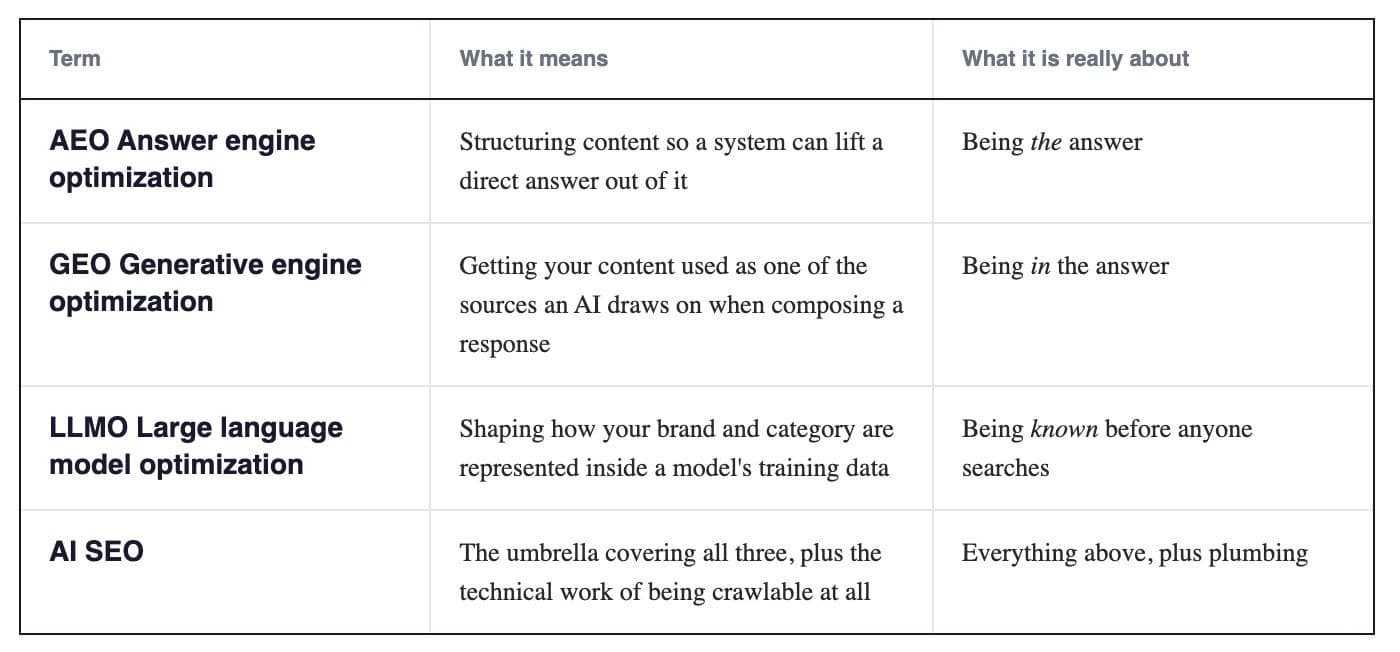
The distinction that matters in practice is AEO against GEO, and it is smaller than the acronyms suggest.
Generative engine optimization (GEO)
GEO is the newer term and the only one with a formal academic definition behind it.
Researchers from Princeton and collaborating institutions introduced it in a paper presented at the KDD conference, defining it as a framework for helping content creators improve how visible their content is inside generative engine responses. They built a benchmark of 10,000 queries across 25 domains and tested nine ways of rewriting content to see which ones increased citation rates.
Three worked: adding specific numerical statistics, adding quotations from named sources, and adding outbound citations to credible primary sources. Keyword stuffing did not work and sometimes made things worse.
The useful part of that definition is the word generative. GEO assumes the system is writing something new from several sources at once, so the goal is to be one of the sources it reaches for. You are not trying to win a slot. You are trying to be in the pool.
Use GEO when you are talking about ChatGPT, Perplexity, Claude or Google's AI Mode composing a multi-paragraph answer from several places.
Answer engine optimization (AEO)
AEO is older, and it grew out of optimising for Google's featured snippets and People Also Ask boxes.
The core idea is structural. Write so a system can lift a clean, self-contained answer out of the page: a tight definition near the top, one question resolved per section, claims stated plainly rather than buried in a narrative.
If you have ever written a 40-word definition block at the top of a page specifically to win a snippet, you have already done AEO. The same technique now applies to AI answer boxes rather than to a grey card above the organic results.
Use AEO when the goal is a single extractable answer, and when the surface in question is Google's.
There is a fuller treatment of what actually earns an AI citation, including what the current research says about ranking, which covers the practical side of this in more depth than a glossary should.
Large language model optimization (LLMO)
LLMO is the long game, and the one you have the least control over.
A model's training data is fixed at a cutoff. Whatever was widely said about your company in reliable sources before that date is baked into the model's weights. You cannot update it retroactively, and you cannot opt out of what is already there.
What you can do is feed the next training cycle. Reviews, community discussion, press coverage, analyst mentions and reference entries all become the material a future model learns from.
Two things follow. LLMO is slow, measured in model generations rather than quarters. And it is mostly not a website exercise, because the material that matters sits on properties you do not own.
Use LLMO when you mean how a model describes your category from memory, with no browsing involved.
AI SEO
AI SEO is the umbrella term, and it is the one most agencies have adopted because it covers everything they already sold.
It spans traditional technical SEO, which still decides whether a crawler can read your page at all, plus AEO and GEO on top. The technical layer matters more than it sounds: content behind a form, content that only renders after JavaScript loads, or a page blocked to the wrong crawler is invisible regardless of how well written it is.
Use AI SEO when you need one phrase for the whole stack, from "can the crawler read this" to "does the model recommend us".
What actually changed, and what got renamed
A fair amount of what is sold as a revolution here is ordinary SEO in new packaging. Clear writing, direct answers, credible sources and sensible structure have been the job for twenty years.
Three things did change.
1. The unit moved from the page to the passage. Retrieval systems break pages into chunks and evaluate each one. A strong paragraph inside a mediocre article can be cited, and a weak opening can get a good page filtered out.
2. The goal went binary. There is no position three inside a synthesised answer. You are in it or you are not.
3. Third-party consensus became its own signal. In search, links from authoritative sites passed ranking signals. In AI answers, whether your brand is independently discussed across review sites, communities and media acts as a separate credibility input on top of link authority.
Nothing in that list requires a new department. It requires writing that makes specific, checkable claims.
Which one should you actually use?
In conversation, GEO and AEO are used interchangeably by most people, and correcting them is rarely worth the energy.
If you need to be precise:
Say AEO when the work is structural and the target is one extractable answer.
Say GEO when the work is about being one of several sources in a composed response.
Say LLMO when you mean training data rather than live retrieval, which is a different problem on a different timescale.
Say AI SEO when you are describing the whole programme to someone who does not need the distinction.
The acronym matters far less than whether anyone has checked which surfaces actually cite you, and whether the pages you care about say anything specific enough to quote.
Which of your pages actually get cited
The practical question for a demand gen team is not which acronym to use. It is which pages to fix first.
Two things decide that, and they are not the same thing. Some page types get cited often. Some get cited by people close to a decision. The ones worth fixing first score on both.
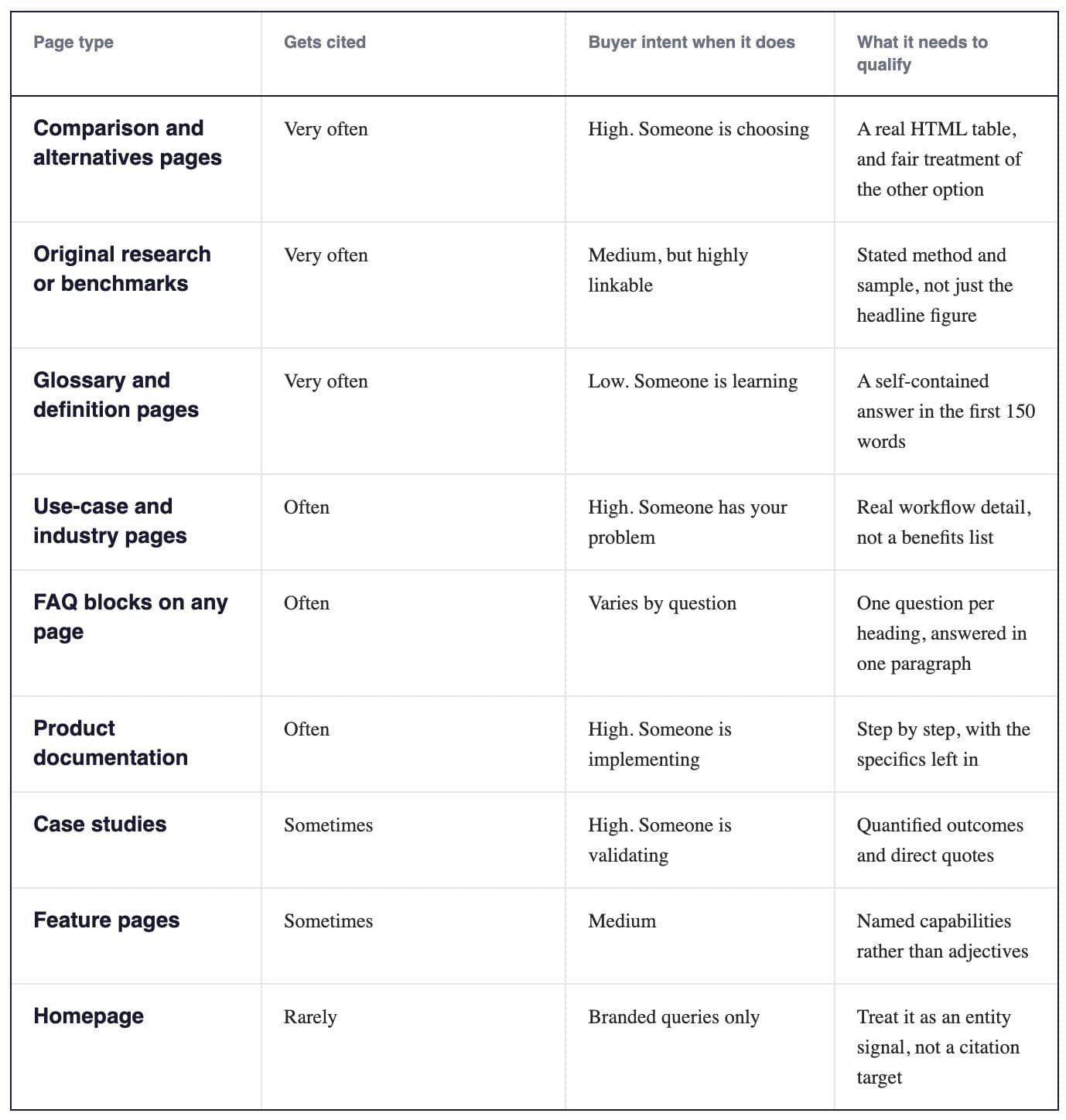
That ordering is a practical judgement rather than a measured ranking, so treat it as a starting sequence rather than a league table.
The useful insight for lead gen is the gap between the first and third rows. Glossaries get cited constantly and convert almost nobody, because the person asking what a term means is not buying. Comparison and alternatives pages get cited nearly as often and the reader is already choosing. If you only have budget to fix two page types, fix those two.
What to add to a page you already have
None of this requires new content. Most of it is editing.
1. A direct answer in the first 150 words. Thirty to fifty words resolving the question the page exists to answer, self-contained enough to be lifted out on its own.
2. Two specific statistics, each linked to its source. Not ranges, not "significant improvement". Your own original data is worth the most, because no model can already know it.
3. A comparison table in real HTML. If the specifics live inside an image or a screenshot, no retrieval system can read them.
4. An FAQ block with one question per heading. These punch above their weight because somebody has already cut them to extractable size.
5. A visible last-updated date. Freshness is weighted differently across engines, and it costs nothing.
6. Two or three outbound links to primary sources. Counterintuitive, and well supported by the research above: citing credible sources signals your claim rests on something checkable.
And one thing to stop doing: putting pricing, feature comparisons or specifications inside images. It is the most common way a page makes itself unreadable to the systems you are trying to reach.
Where pf1 fits
pf1, from the house of Paperflite, is an agentic growth team, and Lead is the agent pointed at this work. Its stated job is getting found through SEO and AEO, and the line on its page puts the requirement well: written for buyers, engineered for engines.
Most teams are not short of raw material for this. The marketing collateral you already own, the reports, guides, case studies and one-pagers, is full of exactly the specifics the table above asks for: real figures, named customers, quantified outcomes. It is usually locked in formats no retrieval system can read. A PDF behind a form, a deck, a comparison table saved as an image.
So the gap is rarely a content gap. It is a format and distribution gap, and it is the cheapest one on the list to close. The mechanism is stated plainly too. Lead detects the terms your buyers search and builds pages from your approved knowledge, with llms.txt and markdown built in, and its page claims that as AEO evolves your pages evolve with it.
On the lead gen question specifically, the capabilities it names are dynamic pages, visitor personalisation, intelligent gating and performance insights. The use cases it lists are closer to the table above than the acronyms are: a page for every buyer at every target account, and turning the reports and guides you already have into leads.
See what your own content answers cleanly today.
The short version
AEO is being the answer. GEO is being in the answer. LLMO is being known before the question is asked. AI SEO is all of it plus the plumbing.
Three of the four reward the same behaviour: say specific things, attribute them, and make them easy to lift out of the page.
FAQ
What is generative engine optimization (GEO)?
Generative engine optimization is the practice of getting your content used as one of the sources an AI draws on when it composes an answer, rather than ranking as a link beneath it. The term was formally introduced in research presented at the KDD conference by a team from Princeton and collaborating institutions, who built a benchmark of 10,000 queries and tested nine ways of rewriting content. Adding specific statistics, quotations from named sources and outbound citations to credible primary sources were the approaches that increased citation rates.
What is the difference between GEO and AEO?
AEO, answer engine optimization, is about being the answer: structuring a page so a system can lift one clean, self-contained response out of it, which grew out of optimising for featured snippets. GEO, generative engine optimization, is about being in the answer: becoming one of several sources an AI uses while composing a multi-paragraph response. AEO is older and more structural, GEO is newer and assumes synthesis. In everyday use the two terms are often swapped, and the practical work overlaps heavily.
What does LLMO mean?
LLMO, large language model optimization, is shaping how your brand, product or category is represented inside a model's training data rather than in live retrieval. A model's training has a cutoff, so whatever was widely said about you in reliable sources before that date is already in its weights and cannot be updated retroactively. What you can influence is the next training cycle, through reviews, community discussion, press coverage and analyst mentions. It is slow, and most of it happens on properties you do not own.
Is AI SEO the same as GEO?
No, AI SEO is broader. It is the umbrella term covering traditional technical SEO, which decides whether a crawler can read your page at all, plus AEO and GEO on top. The technical layer still matters: content behind a form, content that only appears after JavaScript renders, or a page blocked to the wrong crawler is invisible to AI search no matter how well it is written. GEO is one component of AI SEO rather than a synonym for it.
Is any of this actually new, or is it rebranded SEO?
Partly rebranded. Clear writing, direct answers, credible sources and sensible structure have been the job for years. Three things did change. The unit moved from the page to the passage, since retrieval systems evaluate chunks rather than whole documents. The goal went binary, because there is no position three inside a synthesised answer. And third-party consensus became a separate credibility signal rather than only a source of link authority.
Which term should I use with my team?
Use AEO when the work is structural and aimed at one extractable answer. Use GEO when the aim is being one of several sources in a composed response. Use LLMO when you mean training data rather than live retrieval, since that is a different problem on a different timescale. Use AI SEO when describing the whole programme to someone who does not need the distinction. Most people use GEO and AEO interchangeably, and correcting them is rarely worth the effort.
Paperflite's Content Technologyin Action
It's Easier Than Falling Off a Log
(Don't Ask Us How We Know That)

