
Mutual Action Plan: A Template Built Around the Buyer
Oct 28, 2026
A mutual action plan is a shared, dated list of the steps both sides take to reach a decision, agreed with the buyer rather than sent to them.
Most of them do not work, and the reason is visible in the first column. They list the seller's stages: demo, proposal, security review, legal, signature. That is a sales process with the buyer's name written on it.
Here is a template organised the other way round, by what the buying group actually has to get done.
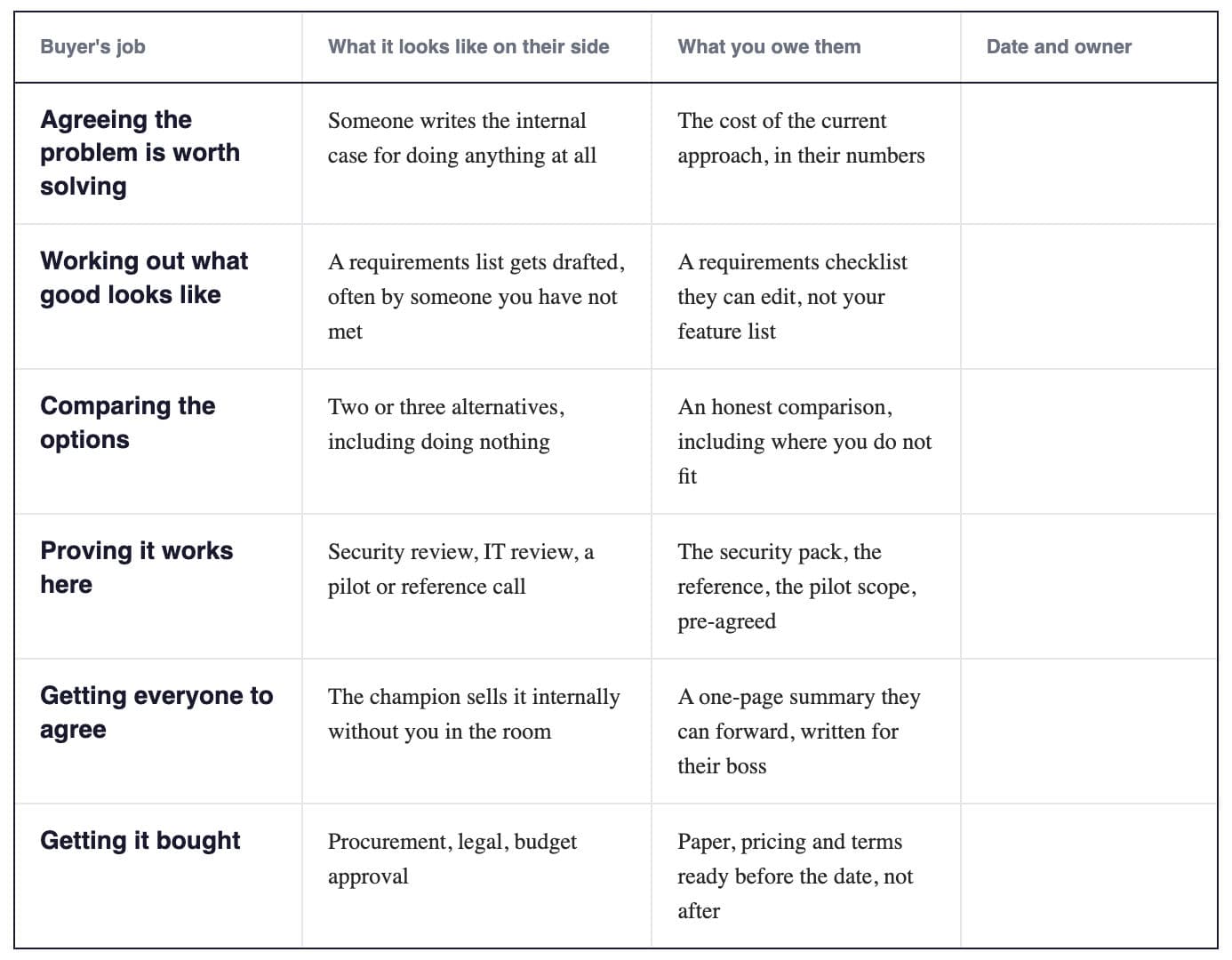
Fill the last column with real dates and real names, theirs and yours. If a row has no name on the buyer's side, that job is not being done, which is usually the row the deal dies on.
Why most mutual action plans stall
A plan built from your pipeline stages measures your progress, not theirs. It tells you when the demo happened. It tells you nothing about whether anyone has written the internal business case, and that is the step that decides most deals.
Gartner's buyer enablement research describes six jobs every B2B buying group has to complete: problem identification, solution exploration, requirements building, supplier selection, validation and consensus creation. Buyers loop between them rather than moving through in order.
Line those six up against a standard plan. Supplier selection is in there, usually as "evaluation". The rest are either missing or compressed into a single row called "internal approval".
The three jobs your plan is missing
Three of the six end up invisible, and they are the hard ones.
1. Requirements building. Often done by someone you have never spoken to, in a document you never see, using criteria you did not shape.
2. Validation. Security, legal and IT reviews that your champion has no authority over and no visibility into.
3. Consensus creation. Your champion persuading five colleagues, in meetings you are not in, with material you did not write.
None of those appear on a plan that tracks demo, proposal, signature. Any of them can stop a deal.
Build it with them, not for them
A plan you write and send is a proposal. A plan you build together is a commitment, and the difference shows up in whether dates hold.
Draft it live, in the call. Share your screen, start with the buyer's jobs and ask what each one looks like inside their company.
Make them name the owners. The useful question is not "when can you get this signed", it is "who writes the requirements, and when do they start". If your champion cannot answer, you have found the risk.
Put the uncomfortable rows in. Budget approval, competing priorities, the person who has to be convinced and has not been. A plan that only contains easy steps is a plan nobody consults.
One caveat on all of this. There is no independent research showing mutual action plans improve win rates, and the figures in circulation come from companies selling the software. What is well evidenced is the behaviour underneath: a Gartner survey of 646 B2B buyers published in 2026 found 67 per cent prefer a rep-free experience, and buyers who felt confident were twice as likely to report a high-quality deal. A plan is a reasonable response to that. Whether yours helps depends on whose work it maps.
The plan that maintains itself
Everything above has the same weak point: a plan nobody reopens is a document.
That gets described as a discipline problem. It is closer to an arithmetic one. Six rows, thirty live deals, and a buyer-side owner on every row whose behaviour you cannot see. No rep reviews that weekly, and the ones who try do it on the deals they already feel good about.
This is the part where an agent changes the shape of the job rather than doing the same job faster.
pf1, from the house of Paperflite, is an agentic growth team, and two of its six agents sit on either side of the plan.
Building it. Experience goes from a prompt to a finished interactive experience, built from your approved content in a single click, and sales proposals and deal rooms are named use cases on its page. The plan and the room around it stop being an assembly job that competes with selling time.
Watching it. Deal is designed to show which deals are in trouble and what reps should do next by comparing live deals with your win/loss history. Its page states the premise plainly: CRM updates alone can miss what buyers are actually doing.
Deal's own page maps this moment as a step in how it works: a champion brings in the buying committee, and the rep creates one shared experience shaped around the stakeholders and the decision. That is a mutual action plan described from the inside, as a thing the deal produces rather than a template a rep fills in.
The watching half is what a document cannot do. A date slipping by a week means nothing by itself. Whether it matters depends on how your deals usually run, and that answer lives in your own history rather than in the plan. Deal checks buyer activity, investigates the evidence and compares similar deals, so the rep hears which row moved and whether that kind of movement usually precedes a loss.
See what your live deals are already telling you.
Where the plan should live
Not in email. A plan sent as an attachment is out of date the moment a step moves, and every stakeholder ends up working from a different version.
It belongs wherever the buying group already goes for everything else about the deal, which for most teams means inside a digital sales room alongside the pricing, the security answers and the recordings. One link, current for everyone, and a new stakeholder can see where things stand without a catch-up call.
That also turns the plan into a signal. If nobody has opened it in nine days, the deal has probably moved somewhere you cannot see. There is more on how deal rooms work in practice and the best way to share them with a buying group.
Try it on one deal
Take a deal currently sitting in your pipeline with a date you do not believe.
Write out the six buyer jobs. Against each one, put the name of the person on their side who owns it and the date they expect to finish. Where you cannot fill a cell, you have found what the deal is actually waiting on.
Most reps find at least two blanks, and they are rarely the rows anyone was worried about.
FAQ
What is a mutual action plan?
A mutual action plan is a shared, dated list of the steps both the buyer and the seller take to reach a decision, agreed together rather than sent across. It is sometimes called a close plan, mutual close plan or joint execution plan. The useful versions list the buying group's own jobs, such as writing requirements or securing internal consensus, with named owners and dates on the buyer's side. The weak versions list the seller's pipeline stages and track the seller's progress instead.
What should a mutual action plan include?
Six things, matching the jobs a buying group has to complete: agreeing the problem is worth solving, defining what good looks like, comparing options including doing nothing, proving it works through security and IT review, building internal consensus, and completing procurement. Each row needs a date, an owner on the buyer's side and what you owe them to unblock it. A row with no buyer-side owner means the job is not being done, which is usually where the deal stalls.
Why do mutual action plans fail?
Usually because they track the seller's stages rather than the buyer's work. Gartner's buyer enablement research identifies six jobs every B2B buying group completes, and the three hardest are internal: building requirements, validating the choice through security and IT, and creating consensus among colleagues. A plan listing demo, proposal and signature captures none of those. Plans also fail when they are written and sent rather than built with the buyer, and when nobody reopens them after the first call.
Do mutual action plans actually improve win rates?
There is no independent research demonstrating it. The figures in circulation come from companies selling the software, generally without sample sizes or stated method. What is well evidenced is the buying behaviour that makes a plan reasonable: a Gartner survey of 646 B2B buyers published in 2026 found 67 per cent prefer a rep-free experience, roughly two-thirds of buying-journey learning comes from information buyers find themselves, and buyers who felt confident were twice as likely to report a high-quality deal.
When should you introduce a mutual action plan?
Once the buyer has agreed there is a problem worth solving and before requirements are written, which is usually earlier than most reps attempt it. Introducing it after the proposal turns it into a closing tool, and buyers read it that way. Introducing it while requirements are still forming makes it mutual in fact rather than in name, because you are shaping work they have to do anyway. The opening question that works is what each step looks like inside their company, not when they can sign.
Where should a mutual action plan live?
Somewhere both sides can see the current version, which rules out email attachments. A plan sent as a file is stale as soon as a date moves, and the buying group ends up working from different copies. Most teams keep it in a digital sales room alongside pricing, security answers and recordings, so a new stakeholder can see where things stand without a catch-up call. Keeping it in a shared space also makes it a signal, since you can see whether anyone has opened it.
What is the difference between a mutual action plan and a close plan?
In practice they describe the same document, but the names point in different directions. A close plan is named after the seller's outcome and tends to be written as the steps to signature. A mutual action plan is named after the shared work and tends to include the buyer's internal jobs. The distinction matters less than whether the buyer helped build it and whether their side of the plan has real owners and dates on it.
Paperflite's Content Technologyin Action
It's Easier Than Falling Off a Log
(Don't Ask Us How We Know That)

