
What Should a Sales AI Agent Be Allowed to Do Without Human Approval?
Oct 21, 2026
Assistant and agent get used as if they sit on a scale, with agent meaning the same thing but more. They do not sit on a scale. One of them answers you and the other one notices things, and a tool that answers brilliantly can leave open the exact gap that a far less impressive tool would have closed.
So the difference between AI agents and AI assistants in sales enablement is not a question of which one is smarter. It is a question of who starts the work. That single distinction decides which jobs you can hand over, what has to be true about your content before you hand them over, and who carries the blame when a handover goes wrong.
Most explainers on this topic will hand you a taxonomy: autonomy, memory, tool use, goal orientation. All true, all abstract, and none of it tells you which jobs to hand to which, or what has to be in place before either one earns its seat. So here is the version written for someone who actually has to make that call.
The actual difference is who starts the work
An AI assistant in sales enablement responds when a rep asks it something: it finds content, summarises a deal, drafts an email on request. An AI agent works from a goal rather than a prompt. It monitors signals, decides what to do next, and takes the action, with a human approving only what you decide needs approval.
Everything else people list as a difference follows from that one. An assistant does not need long-term memory because the prompt carries the context. An agent needs memory because nobody is there to re-explain the deal every morning. An assistant does not need write access to your CRM because the rep is the one typing. An agent needs it because the whole point is that the rep is not typing.
The practical read: an assistant sits on the end of a question, and an agent sits on the end of a condition. "Tell me which assets Acme opened" is a question. "When a buyer on an open deal opens pricing twice in a week and the rep has not replied in two days, surface it" is a condition. Same underlying model, completely different operational contract.
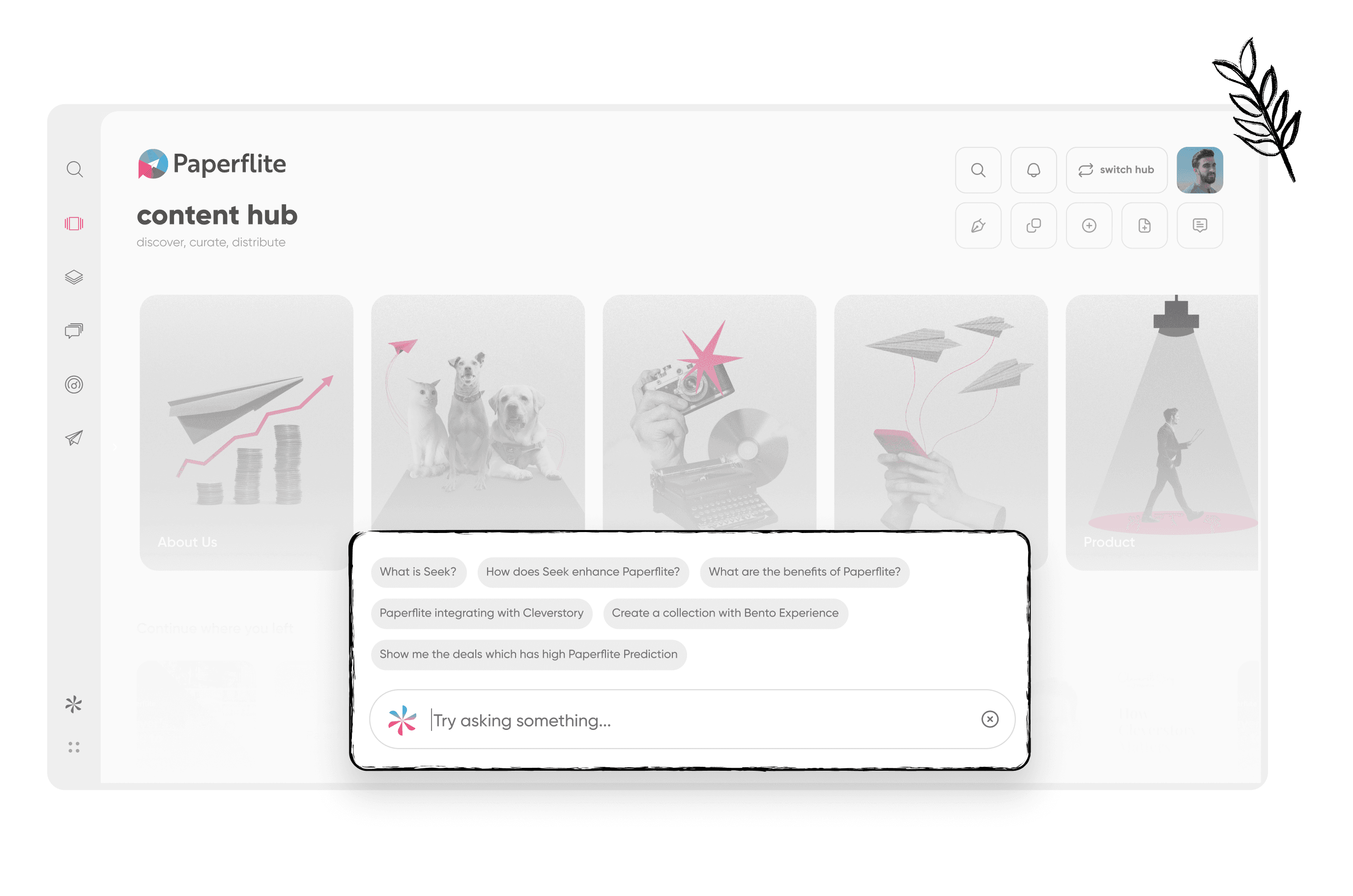
An assistant waits for the question: prompt suggestions and an ask box sitting over the content hub.
Five things that separate an agent from an assistant
The five differences worth knowing are easier to hold as a sequence than as a grid. What starts it: an assistant waits for a human prompt, and an agent starts from a goal, a schedule, or a signal. Memory: an assistant usually works inside the current session, while an agent carries persistent state across the deal or the account. Tool access: an assistant reads, retrieves, summarises and drafts, and an agent needs write access on top of that, so it can send, update, create and assign.
Then the two that matter most. Decision rights: an assistant has none, it proposes and the human disposes, whereas an agent decides within boundaries you set in advance. Accountability: when an assistant produces something, the rep who used it owns the output, and when an agent acts, the policy you wrote owns it.
That last one is the one teams skip, and it is the expensive one. When an assistant drafts a bad email, a rep reads it and deletes it. When an agent sends a bad email, the policy you wrote six weeks ago sent it. That is not a reason to avoid agents. It is a reason to write the policy on purpose instead of inheriting it from a default setting.
What each one is actually good at
Assistants are strongest where the bottleneck is recall. A rep knows what they need and cannot find it, or knows what happened and cannot remember the specifics. Retrieval, summarising a long thread, pulling the three assets that worked on similar deals, drafting a first pass at a recap. These are all jobs where a human is already engaged and just needs the friction removed. Most of what gets sold as How AI Drives Sales Enablement today is this, and it is worth having.
Agents are strongest where the bottleneck is attention. Nobody forgot how to write a follow-up. They forgot to write it, because the signal arrived while they were on another call. Monitoring engagement across forty open deals, noticing that a champion went quiet, spotting that a stage close date is now in the past, queueing the next action in priority order: none of that requires intelligence so much as it requires someone to be looking all the time, which no rep is. An agentic revenue enablement workflow is mostly a watching problem dressed up as a thinking problem.
The division is not glamorous but it is clean. Hand the assistant anything where a human has already decided to act. Hand the agent anything where the trouble is that nobody noticed there was something to act on.
Think about the two pieces of software in a car. The satnav is an assistant: you type a destination, it returns the best route, and it is very good at a job you have already decided to do. The parking sensor is an agent. Nobody asks it anything. It watches continuously, and when the gap behind you closes to a threshold somebody set, it beeps whether you were paying attention or not. You would not replace the satnav with the sensor, and you would not try to reverse into a tight space using directions you typed in advance. Pipeline coverage has the same shape. Some of it is route-finding, and some of it is the thing nobody is looking at.
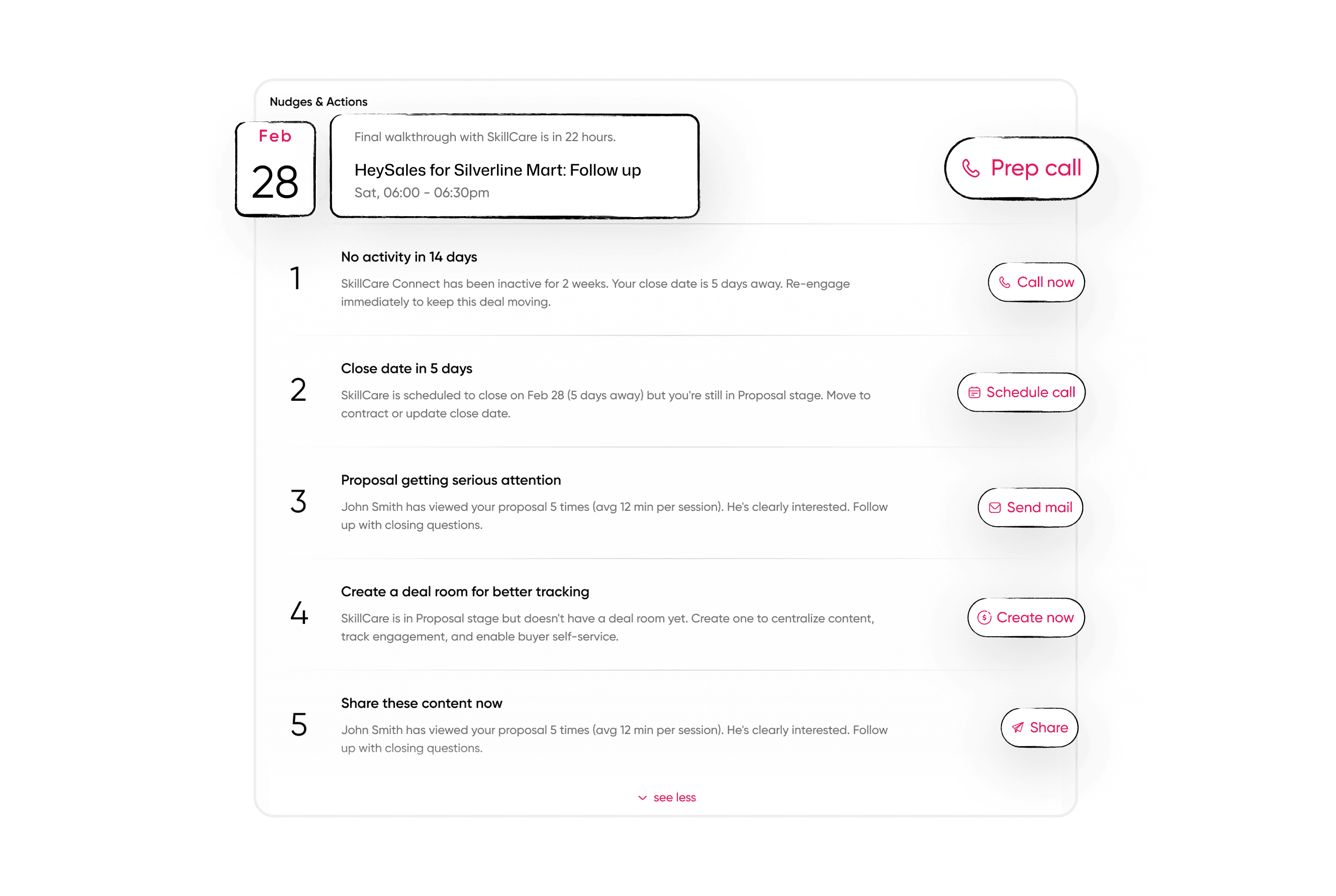
An agent produces a queue the rep did not ask for: the day's actions, ranked, with the signal that triggered each one.
Can an AI agent act without human approval?
Technically yes, and in most sales enablement rollouts it should not, at least not at first. The useful model is tiers: let the agent read and analyse freely, draft with no approval, send internally with no approval, and send externally or write to the CRM only with a human in the loop until you have a few months of evidence that its judgment holds.
Those four tiers (read, draft, send internal, act external) are worth writing down literally, as a table your team signs off on, because the alternative is that every rep discovers the boundary by accident. The honest position here: most teams should not let an agent email a buyer unsupervised in month one. Not because the model will hallucinate a product feature, though it might, but because you will not yet know which of your content it reaches for, and a confidently-sent outdated one-pager is a worse outcome than a follow-up that went out a day late.
The tradeoff is real in both directions. Keep a human on every action and you have rebuilt the assistant with extra steps, and you will get assistant-level results. Loosen too early and you are letting a system act on a content library nobody has audited. Pick the tier per action type, not per tool, and move individual actions up as they earn it.
What has to be true before an agent is useful at all
Here is the part the category explainers leave out, and it is the part that decides whether any of this works for you.
An agent inherits your content layer. Every bit of it. If the hub has four versions of the security one-pager and the current one is the one named final_v3_USE_THIS, an assistant will surface all four and a rep will squint and pick right. An agent will pick one and send it. If permissions are loose enough that a partner-facing deck sits in the same folder as an internal pricing sheet, the assistant shows a rep something they already had access to, and the agent attaches it to an external share.
So the prerequisites are not AI prerequisites. They are housekeeping, and they are boring, and they are the entire gating factor:
- One current version per asset, with the superseded ones archived rather than renamed
- Metadata that means something: stage, persona, product, expiry, and approval status, populated rather than optional
- Permissions that reflect audience, so internal and external material are not neighbours
- An owner per content area who is accountable for freshness
- A retrieval layer the agent and the reps share, so what the agent reaches for is what a human would have reached for
None of that is new advice. Good Content Hub Operations has wanted all five for years. What changed is the cost of ignoring it. A messy library used to produce a rep who wasted ten minutes. A messy library handed to an agent produces a buyer holding last year's pricing. The question of what context agents need is really the question of whether your content is describable, and most libraries are not, yet.

The unglamorous prerequisite: a folder and category structure an agent can actually navigate without guessing.
Do agents replace reps or enablement teams?
No. Agents move work rather than remove it. They take over the recall and monitoring that humans are bad at, which leaves reps with the judgment calls and enablement teams with the governance that agents depend on. The job that shrinks is remembering. The job that grows is deciding what good looks like and writing it down.
For enablement specifically the shift is from producing content to defining the rules an agent operates under: what is approved, what is current, what may be sent to whom, what triggers an action. That is closer to policy work than to content work, and it is why understanding the key differences between revenue and sales enablement matters more once agents are in the picture. Somebody has to own the boundary. It will not be the model.
Where pf1 sits
Worth naming the obvious conflict of interest: pf1, from the house of Paperflite, builds agents on both ends of this, which is why the distinction is easier to show than to describe. Knowledge is the asking end. It holds one validated source of truth and returns the right answer mid-deal with its source attached. Deal is the watching end. It reads CRM activity, emails, call transcripts and what buyers actually open, scores each deal against your own win and loss history, and flags the ones going wrong before a rep has thought to check.
Note what Deal does not claim. It does not send anything on its own. It watches continuously, which no rep can, and hands back a ranked list with the reason and the next move attached. That is the honest shape of most useful agents today, and the dial belongs to the customer: set approval gates where you want them, keep an audit trail, and move individual actions up as they earn it.
Both ends running on the same knowledge layer is the argument this article has been making from the start. An agent that is not grounded in what your business knows to be true is only generating language, fluently and confidently. Grounding is what makes it right rather than merely convincing.
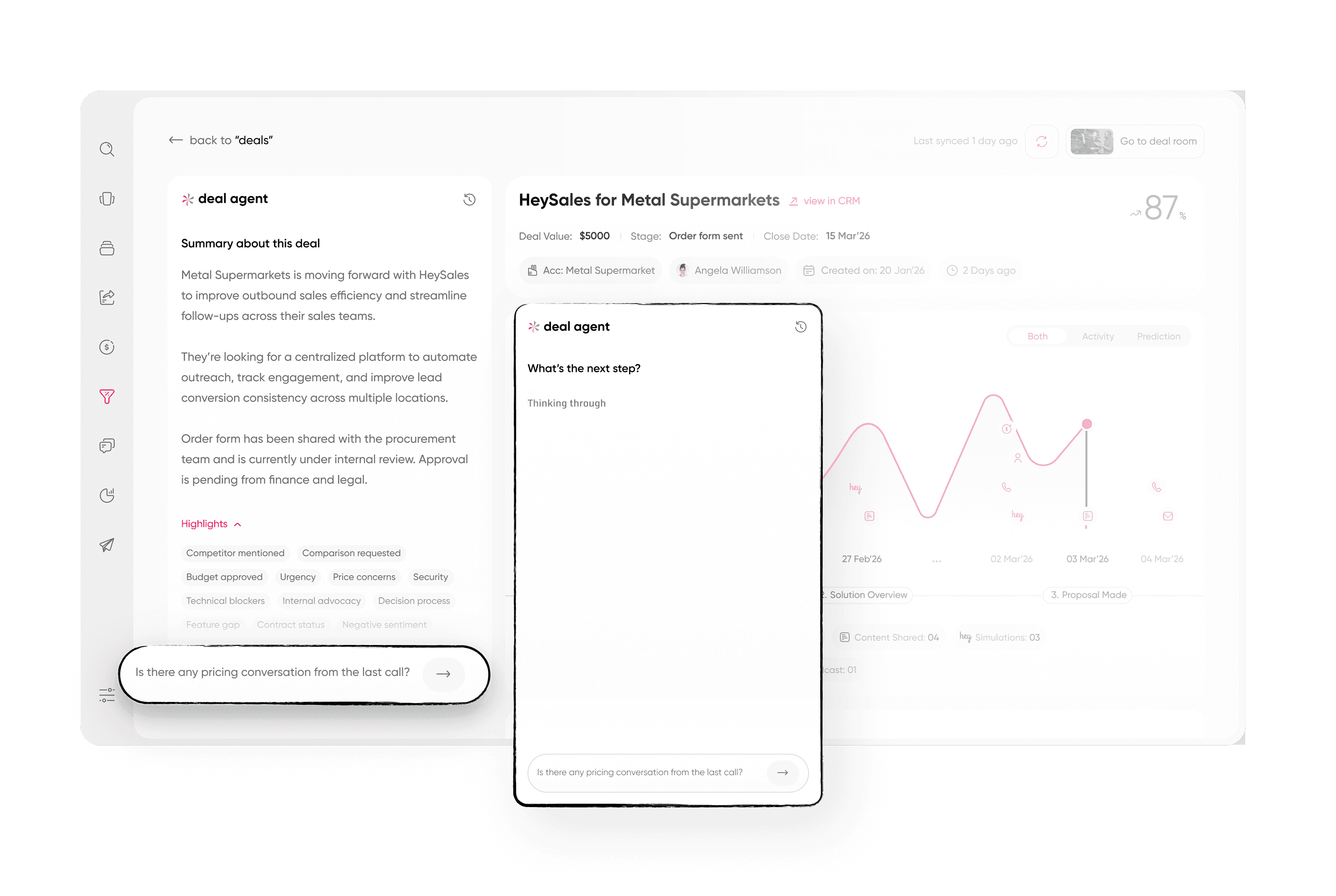
Asking Deal a question inside the deal, where the context is already loaded.
The test
The scale was always the wrong mental model, so here is the thing to measure instead. It costs nothing to run on your own stack this week, and it does not require a vendor call.
If your AI found the answer and a human still had to carry it, you have an assistant. Useful, worth keeping, not the thing that fixes the follow-up window. If your AI noticed the window was closing and put the next action in front of someone, you have an agent, and your real work is no longer evaluating models. It is cleaning the content layer underneath, and deciding, in writing, exactly how much that agent is allowed to do on its own.
Still deciding which jobs belong to which?
The four approval tiers and the content prerequisites behind each one fit on a single page you can take into a vendor call, and we will walk you through both modes on your own content when you book a demo.
FAQ
What is the main difference between an AI agent and an AI assistant?
Initiation. An assistant acts when a person prompts it, and an agent acts when a goal or signal tells it to. Differences in memory, tool access, and decision rights all follow from that, because an agent has to operate without a human present to supply context or approve each step.
Can an AI agent work without human approval?
It can, but most sales enablement teams should limit that at first. A workable pattern is to let the agent read and draft freely, send internally without approval, and require a human for anything that reaches a buyer or writes to the CRM. Individual actions can move to full autonomy once there is evidence they are reliable.
Do AI agents replace sales reps?
No. They absorb recall and monitoring work rather than selling work. Reps keep the judgment calls and the relationship, and enablement teams pick up the governance that agents depend on, such as defining what content is approved, current, and allowed to be shared externally.
Which should a sales team adopt first, an assistant or an agent?
An assistant, in most cases. It delivers value without requiring your content library to be clean, because a human filters every result. An agent only becomes trustworthy once versioning, metadata, and permissions are in order, since it acts on what it retrieves without a person checking.
What data does an AI agent need to work in sales enablement?
At minimum it needs a retrieval layer over current content with reliable metadata (stage, persona, approval status, expiry), permissions that separate internal from external material, and access to engagement and deal signals so it knows when to act. Missing metadata is the most common blocker.
Is agentic AI the same as an AI agent?
Agentic AI is the broader term for systems that pursue goals and take actions, and an AI agent is a single instance of one. In practice vendors use the phrases interchangeably, so the more useful question to ask about any product is what it is allowed to do without being asked.
How do you measure whether an AI agent is working?
Measure actions taken and accepted rather than questions answered. Useful signals include how many agent-surfaced actions a rep acts on, how often the agent picks the current version of an asset, and whether response time to buyer signals improves. Query volume tells you about an assistant, not an agent.
Paperflite's Content Technologyin Action
It's Easier Than Falling Off a Log
(Don't Ask Us How We Know That)

