
How Are AI Agents Different from AI Assistants in Sales Enablement?
Oct 21, 2026
By 2027, Gartner expects 40% of enterprises to demote or decommission autonomous AI agents, because the governance gaps only surface after something has already gone wrong in production. That is a prediction about scope, not about capability. The agents in that 40% will not fail for being too clever. They will fail because somebody picked one permission level for every agent in the company, and then found out which actions it was wrong for by having an incident.
Which makes this the right question to ask before a rollout rather than after one. The honest answer is not a single line, though. It is a different answer for every action, and the useful work is deciding which action sits where.
The short answer
A sales AI agent can safely act without approval where the action is reversible, internal, and auditable: reading CRM and engagement data, scoring and ranking deals, surfacing risks, drafting content, and notifying colleagues. Anything that reaches a buyer, changes pricing, or writes a forecast-bearing CRM field should stay behind a human until it has earned promotion.
Reversible, internal, auditable. If an action fails all three tests, it does not belong on autopilot in month one, whatever the demo showed you.
The four autonomy levels, and what each means for a sales team
Gartner's framing is the most useful public one here, and it is worth using rather than inventing a private model. In a June 2026 release, Gartner argued that applying uniform governance to every AI agent is itself a failure mode, and recommended what it calls a proportional governance approach built on four autonomy levels, each treated as its own trust boundary with its own controls.
The levels are Gartner's and the sales mapping is ours. Observe is read-only: the agent can look, and whatever it produces is visible only to the person who asked. In a sales team that covers pulling engagement data, scoring deal health and ranking what is at risk, and it needs no approval at all. Advise adds production without execution: the agent drafts and recommends, and a human carries it out. That covers drafting a follow-up, proposing the next asset and writing a meeting brief, with nothing needed to produce any of it and a person required to act on it.
Act with Approval is the first level that writes. The agent can change data or configuration, but only after a person approves each individual action, which in sales means updating a CRM stage, sending an external share or applying a discount. Act Autonomously lets the agent act inside guardrails you have set, with humans reviewing exceptions and aggregated outcomes rather than individual actions. That suits internal notifications, routine field hygiene and sequencing internal tasks.
Notice that the fourth level is not the most dangerous one. Routine internal hygiene can run autonomously with less risk than a single external send sitting at the third level, which is the point Gartner is making: the level follows the action, not the product. Getting this right starts with knowing the difference between an agent and an assistant, because an assistant never leaves the second level.
What a sales agent can do with no approval at all
Reading is the easy yes. An agent can pull CRM activity, email history, call transcripts and content engagement, score a deal against past wins and losses, rank a pipeline by risk, and put the result in front of the person who owns it. Nothing has changed, nothing has been sent, and if the scoring is wrong the cost is one ignored recommendation.
Drafting is the second yes, and it surprises people. A draft is not an action. An agent can write the follow-up, assemble the meeting brief, and propose which three assets fit this buyer, all without approval, because a human still has to press send. The useful distinction is between producing something and dispatching it. Teams that put an approval gate on drafting have usually confused the two, and they pay for it in latency on the one task where speed actually helps.
Internal notification is the third. Telling a rep that their champion has gone quiet, or telling a manager that four deals slipped this week, moves no money and reaches no buyer. Treat it as routine.
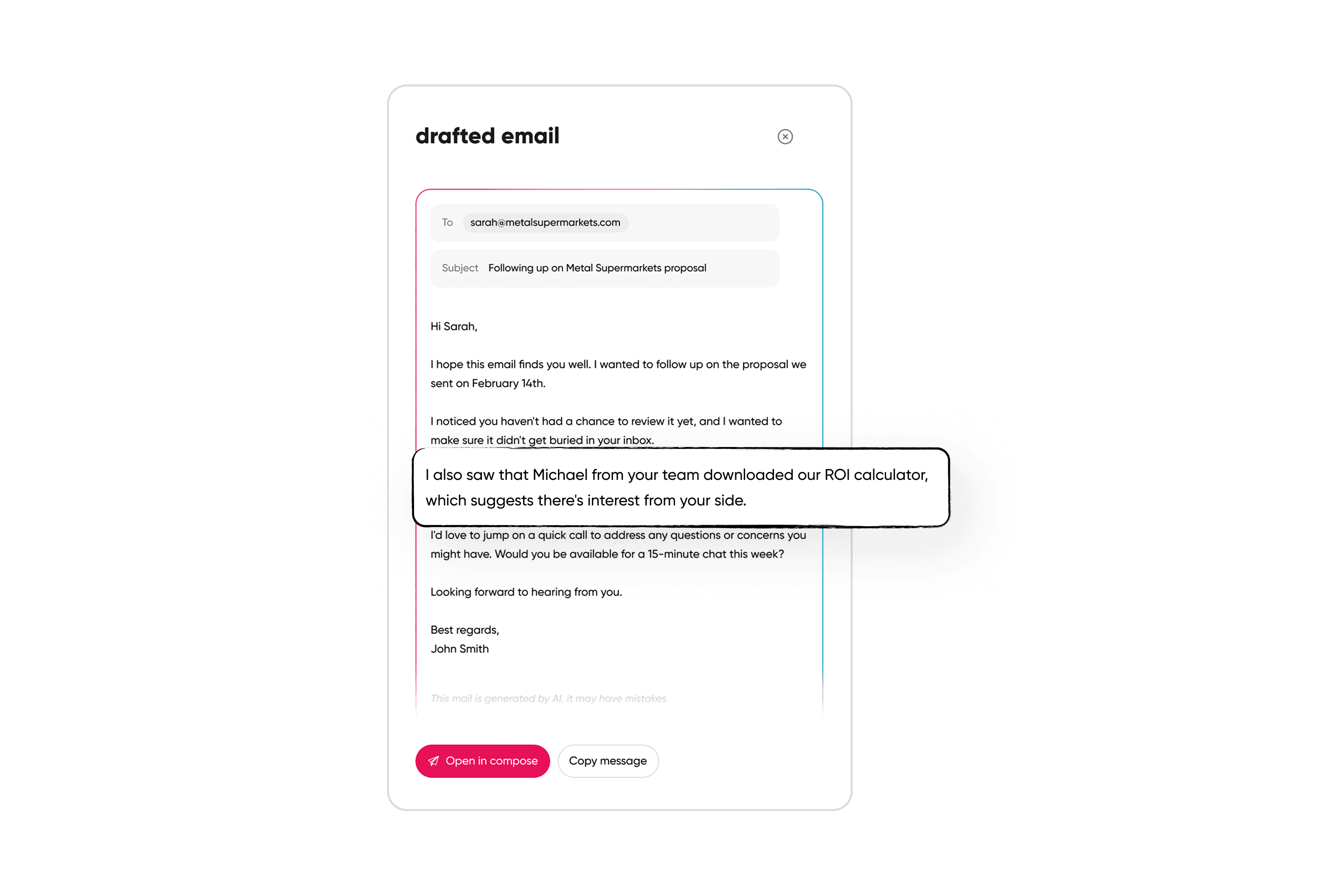
A drafted follow-up waiting on a human: produced automatically, dispatched only by the rep.
What should always keep a human in the loop
Four categories should stay behind a person until there is evidence to move them: anything that reaches a buyer, anything that touches price, anything that writes a CRM field your forecast depends on, and anything making a claim that a regulator or your legal team would want to have approved.
The buyer-facing one is obvious in principle and gets eroded in practice, usually by a well-meaning automation that sends "just a nudge" to a cold contact. Price is obvious too. The forecast-bearing CRM field is the one teams miss: if an agent can move a close date or a stage, it can move the number the board sees, and that is a reporting integrity problem rather than a sales one.
The regulated-claim category is where this stops being a preference. If you sell into healthcare, financial services or anywhere with claim substantiation rules, the content an agent reaches for has to be approved content, which means your content approval workflows are now part of your AI controls whether anyone wrote that down or not. The same applies to governance in regulated industries more broadly: an agent does not get a different compliance standard because it is fast.
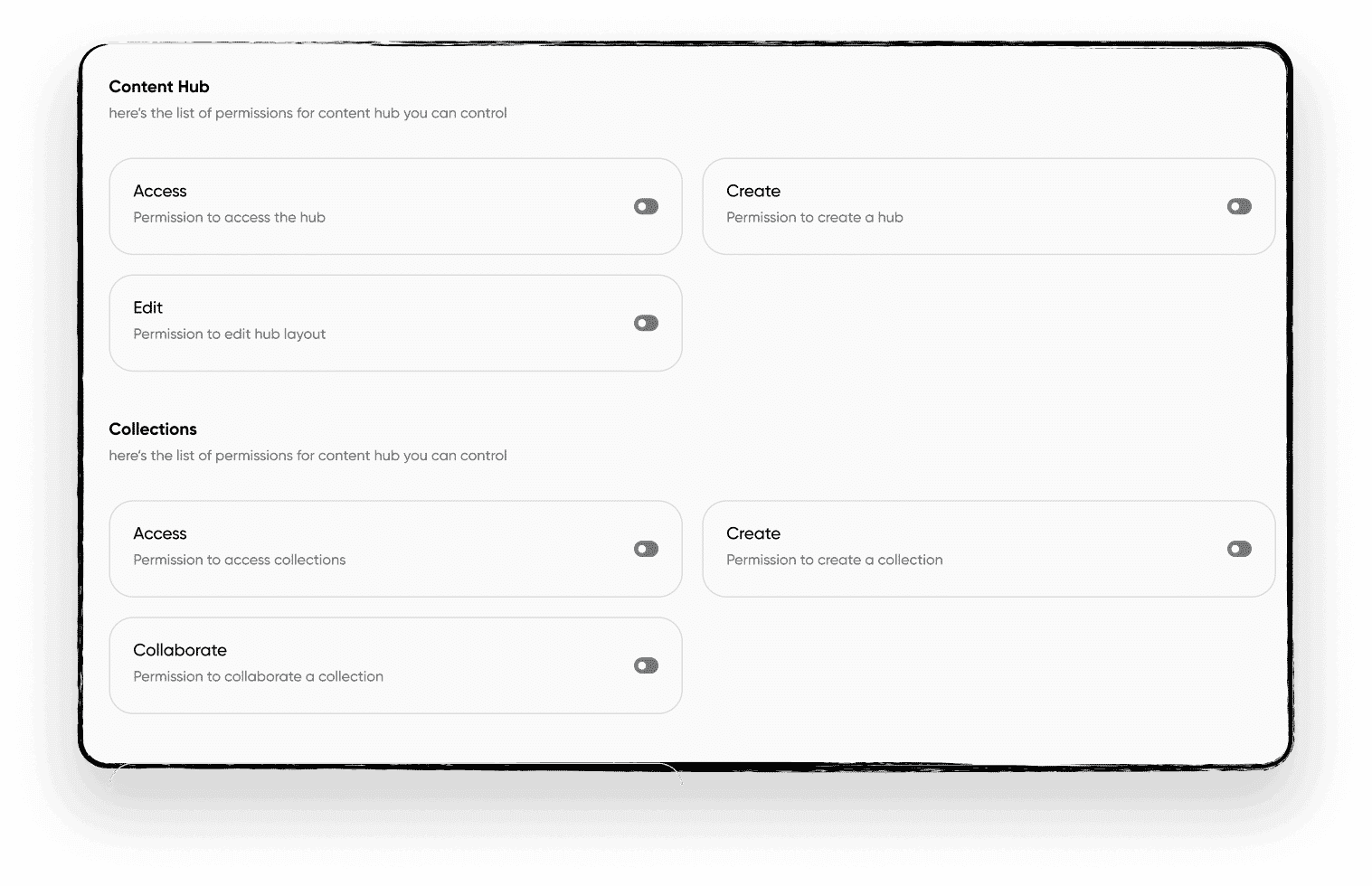
Role permissions are where a tier stops being a policy document and starts being enforced.
Why "approve every action" is not the safe answer
Here is the part that gets left out, and it is the reason this article exists rather than a list.
Putting a human on every action feels like the conservative choice and often is not. Gartner's own warning about the Act with Approval level is that approvals degrade into what it calls a false sense of safety under time pressure and approval fatigue. A rep approving the fortieth suggested action of the morning is not reviewing it. They are clicking. You now have the latency cost of a gate and the risk profile of no gate, which is the worst of both.
The other direction fails too. Over-restricting simple agents, in Gartner's framing, slows delivery and drives shadow development: people route around the governed tool and do the same work in an ungoverned one. Anyone who has watched a team move a workflow into a personal chatbot tab because the approved path took three days has seen this happen.
So the tradeoff is real in both directions, and the resolution is not a dial between them. It is granularity. Set the tier per action type, review the exceptions rather than the volume, and keep the number of things a human must personally approve small enough that approving still means reading. If your approval queue is long enough to skim, it has stopped being a control.
How an action earns its way up a tier
Promotion should be evidence-based and boring. Five tests, and an action needs all five:
- Reversible. You can undo it, and you know how long you have to notice.
- Observed. It ran at the tier below for long enough to produce a track record, not a demo.
- Measured. You know its accuracy rate on your data, not the vendor's benchmark.
- Audited. Every instance is logged with what triggered it and what it did.
- Owned. A named person is accountable for its behaviour, not a committee.
Run the promotion as a decision with a date attached, the way a pilot graduates, and write down what would send it back down a tier. An agentic revenue enablement strategy that never demotes anything is not a strategy, it is a ratchet.
What has to exist before any tier is real
A tier model written in a slide is not a control. Four things make it one.
An audit trail that records what the agent did and why, because without it you cannot investigate the first incident and you certainly cannot promote anything. A rollback path, and for the top tier what Gartner describes as circuit breakers that halt operation when a threshold is crossed. A named owner per agent. And grounded content underneath, because an agent reaching into an unversioned library will act correctly on the wrong document. Which context an agent needs is a question worth answering properly, and what context agents need is the same question as what it is allowed to touch.
Without those four, every tier above Observe is aspirational.
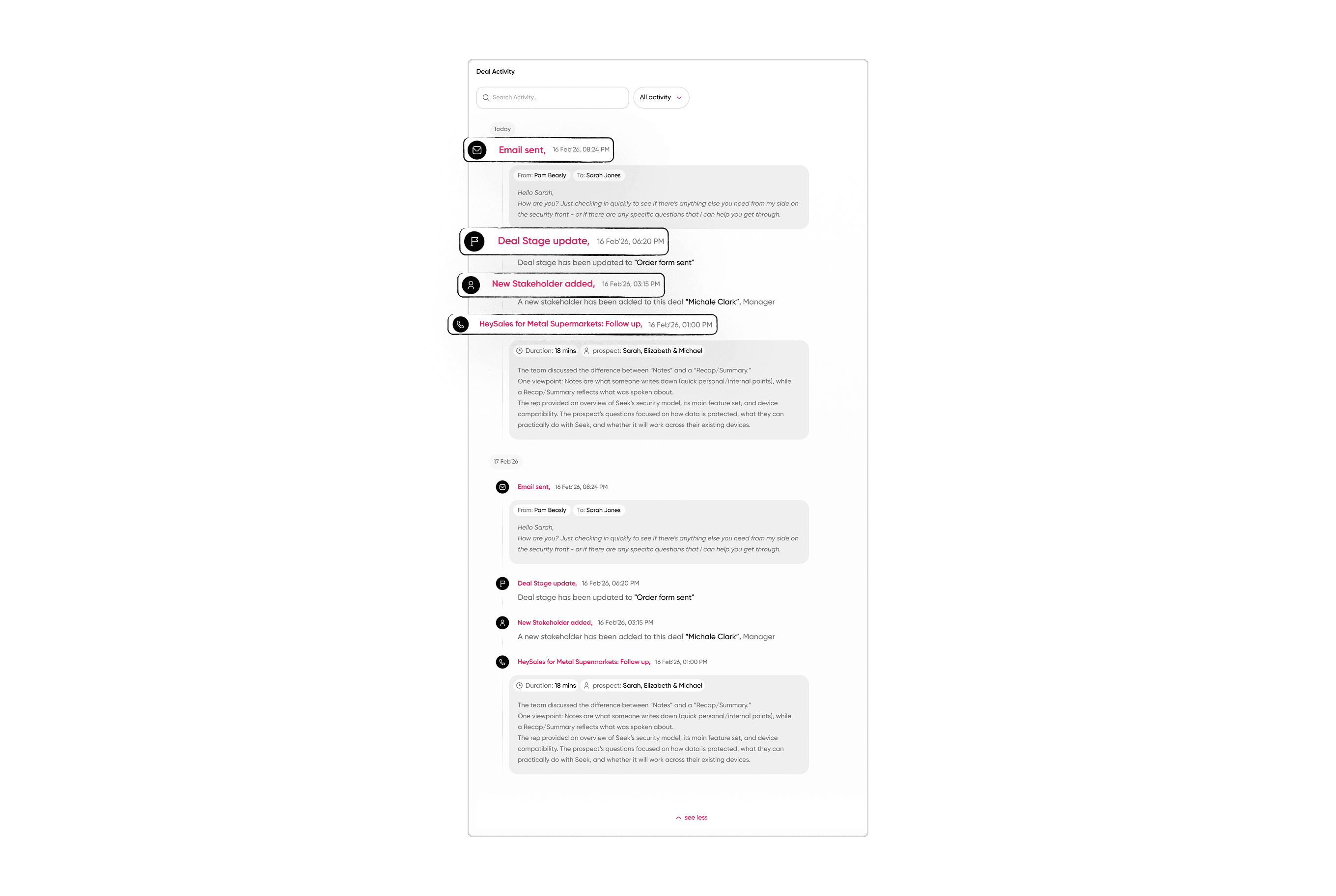
The audit view that makes promotion defensible: what happened on a deal, without anyone having to ask.
Where pf1 sits
Worth naming the obvious conflict of interest: pf1, from the house of Paperflite, builds agents for go-to-market teams, and the approval question is one it answers in product rather than in a policy document. Its position is that the gates belong to the customer: set approval gates where you want them, keep a full audit trail, and control data residency, with brand, rules, voice and permissions enforced on what the agents produce.
The underlying argument is the one this article has been circling. An agent that is not grounded in what your business knows to be true is only generating language, fluently and confidently. Grounding is what makes an action safe to delegate, and governance is what makes the delegation reversible. Neither one is a setting you turn up at the end.
The number to avoid being in
Go back to that 40%. The teams in it will not be the ones who were reckless about autonomy. They will mostly be the ones who treated governance as a single switch, discovered the mismatch through an incident, and pulled the whole thing back rather than the one action that was wrong.
The way out is unglamorous and available this week. List the actions your agent can take. Put each one at a level. Write down what would move it up and what would send it back. Then make sure the audit trail exists before you need it, rather than during the conversation where someone asks what happened.
Want this as something you can take into a governance review?
The approval-tier checklist lists every common sales agent action against the four levels, with the five promotion tests beside each one, and we will walk through where your own actions should sit when you book a demo.
FAQ
What can a sales AI agent do without human approval?
Actions that are reversible, internal and auditable. In practice that means reading CRM and engagement data, scoring and ranking deals, surfacing risk, drafting emails and briefs, and notifying colleagues internally. None of those reach a buyer or change a number, so a wrong output costs an ignored suggestion rather than an incident.
What should a sales AI agent never do without approval?
Four categories: anything that reaches a buyer, anything that changes price or discount, anything that writes a CRM field your forecast depends on, and anything making a claim that legal or a regulator would need to approve. These can move up a tier later, but only with a measured accuracy rate and an audit trail behind them.
Is requiring approval for every action the safest option?
No. Gartner warns that per-action approval can become a false sense of safety under approval fatigue, because someone approving dozens of actions is clicking rather than reviewing. You end up with the delay of a control and the risk of none. Keeping the approval queue short enough that approving still means reading matters more than making it long.
What are the four AI agent autonomy levels?
In Gartner's model they are Observe (read-only, visible to the requester), Advise (drafts and recommendations that humans execute), Act with Approval (writes or changes configuration after per-action human approval), and Act Autonomously (acts within guardrails, with humans reviewing exceptions and aggregate outcomes). Each level is a separate trust boundary with its own controls.
Can an AI agent update the CRM on its own?
It depends on the field. Activity logging and routine hygiene are low-risk and reversible, so they can run autonomously with exception review. Fields that feed the forecast, such as stage or close date, should stay behind a human, because an agent that can move those can move the number leadership reports on.
How do you decide when to give an agent more autonomy?
Treat it as a promotion with evidence. The action should be reversible, already observed running at the tier below, measured for accuracy on your own data rather than a vendor benchmark, fully audited, and owned by a named person. Decide it on a date, and write down in advance what would send it back down.
What has to be in place before letting an agent act autonomously?
An audit trail of what it did and why, a rollback path with circuit breakers that stop it when a threshold is crossed, a named owner accountable for its behaviour, and a governed content layer so it acts on current approved material. Without those four, autonomy is a setting rather than a capability.
Paperflite's Content Technologyin Action
It's Easier Than Falling Off a Log
(Don't Ask Us How We Know That)

