
How to Evaluate Revenue Enablement Software: 9 Criteria
Oct 21, 2026
Search for how to buy software in this category and every result on the first page is a buyer's guide written by someone selling it. Mindtickle has one, Showpad has two, Accent has a 2026 edition, Highspot and SalesHood and DocSend all have their versions. The only evaluation on that page that is not vendor-authored is a Forrester Wave from the third quarter of 2024, which is now two years old.
This article is also written by a vendor. pf1 sells in this category, which means the correct thing to do is tell you that in the first paragraph rather than the last, and then write criteria sharp enough to rule us out when we are the wrong fit. If a buying guide never produces a reason not to buy from its author, it is a brochure with a table of contents.
So the question as usually asked, which is some version of "what is the best revenue enablement software," has no honest answer from anyone in this market. The question that does have an answer is narrower: what are you buying, and what would tell you a given vendor cannot do it.
Decide which of three products you are buying
Revenue enablement software is sold as one category but covers three different products: content management (storing, governing and sharing approved material), training and readiness (onboarding, certification and coaching), and deal execution (buyer engagement, deal rooms and next-action guidance). Decide which of the three is your actual problem before you shortlist, because few vendors are strong at all three.
Most evaluations that go badly went wrong here, before any demo. A team writes a requirements list that spans all three products, scores six vendors against it, and every vendor comes out as 70% fit, because each one is excellent at its own third and adequate at the rest. The scorecard then gets decided by whoever gave the best demo.
The fix is unglamorous: rank the three. Not "all are important," an actual order. If your reps cannot find current collateral, that is a content problem and training features will not fix it. If your reps can find everything and still cannot handle a pricing objection, buying a better content hub will not help. Understanding revenue enablement vs sales enablement matters here mainly because the broader the remit you claim, the more likely you are to buy all three badly.
Nine criteria that actually separate platforms
Feature checklists do not separate vendors, because every vendor ticks every box. What separates them is how they answer a specific question about each capability. Nine criteria, each with the question that tests it:
- Content governance. Show me how a superseded asset stops being findable. Who does that, and does it happen automatically on an expiry date?
- Metadata model. Which metadata fields are mandatory rather than optional, and can I make a field mandatory myself without a services engagement?
- Permissions granularity. Can internal-only and buyer-facing material live in the same folder with different audiences, or does separation depend on folder structure?
- Search and retrieval. Run a search on my content, not yours. What happens when four near-identical versions exist?
- Buyer-side engagement data. What exactly do you capture per recipient per asset, and how long is it retained?
- CRM write-back. Which objects and fields do you write to, who owns the mapping, and what happens when a write fails?
- AI grounding and governance. Which content can the AI reach, who approved it, and can I exclude a folder from it entirely?
- Admin burden. Who maintains this in month six, and how many hours a week has that person spent at your other accounts?
- Exit. Export my content, metadata and engagement history in a format I can load elsewhere. Show me the file.
The second one is the criterion that quietly decides whether the whole thing works. If metadata is optional, it will be empty within a quarter, and everything downstream (search, permissions, reporting, and anything AI touches) degrades from there. Good content hub operations depend on fields being compulsory at upload, and that is a product capability rather than a discipline problem.
The seventh is newer and gets skipped most often. If a platform has AI features, the question is not how good the model is. It is which documents the model can see, because what context agents need is exactly what determines whether the output is trustworthy or confidently wrong.

Asset metadata and tagging: the screen that decides whether criteria two, three, four and seven hold up.
What to pilot instead of demo
Pilot on your own content rather than the vendor's. A demo environment is a curated library with clean metadata and no duplicates, which is the one condition under which every platform in this category performs well. The test that matters is what happens to a messy library, because that is what you are actually migrating.
Four things to put in a pilot, in order of how much they reveal. Load a genuinely difficult slice of your content, including the near-duplicates and the assets nobody owns. Have three reps who did not attend the demo try to find something specific without training. Send one real asset to one real buyer and check what engagement data comes back and how quickly. Then ask the admin how long the setup took, and get the number from them rather than from the vendor.
A pilot structured like that will usually separate a shortlist of three into one obvious answer within two weeks. A demo-led evaluation almost never does, because every vendor is good at demos. They have done thousands.
The integration questions asked too late
Integration is where evaluations get decided after the contract is signed, which is the wrong order. Three questions worth asking before.
What writes back to the CRM, specifically. Not "we integrate with Salesforce," which is true of everything. Which objects, which fields, who owns the field mapping, and what the behaviour is when a write fails silently. If the answer involves a partner or a services engagement, that is a cost and a timeline you have not budgeted.
How users get provisioned and deprovisioned. If someone leaves, does their access end through your identity provider automatically, or does an admin remember to remove them? For regulated buyers this is a security review item rather than a convenience.
And where the data lives. Data residency sounds like a procurement checkbox until a security review stops a rollout over it.
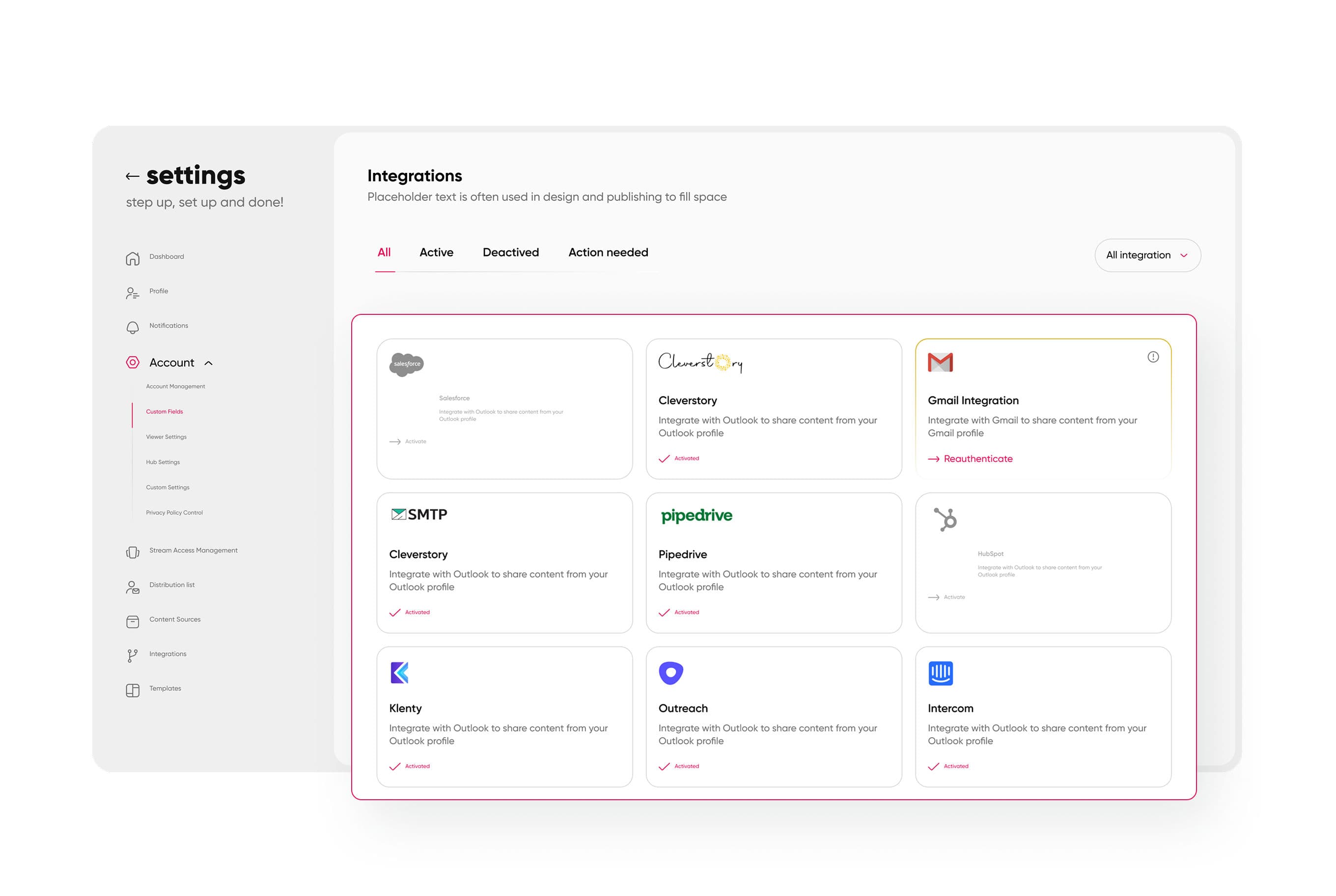
The integrations surface: worth having a vendor open in the evaluation rather than describe in a deck.
How to read an analytics claim
Every vendor in this category claims engagement analytics. The claims differ enormously in what they actually mean, and the distinction is between counting and understanding.
Vanity depth looks like totals: views, downloads, shares. Useful depth is per recipient and per asset, with time spent and sequence, so you can tell the difference between a buyer who opened the pricing page for nine seconds and one who read it twice and forwarded it. The second is a signal you can act on. The first is a number for a slide.
The question to ask is dull and effective: show me one real recipient's engagement on one real asset, with everything you captured. If what comes back is a count, you have a reporting tool. If it is a timeline, you have something a rep or an agent can act on.
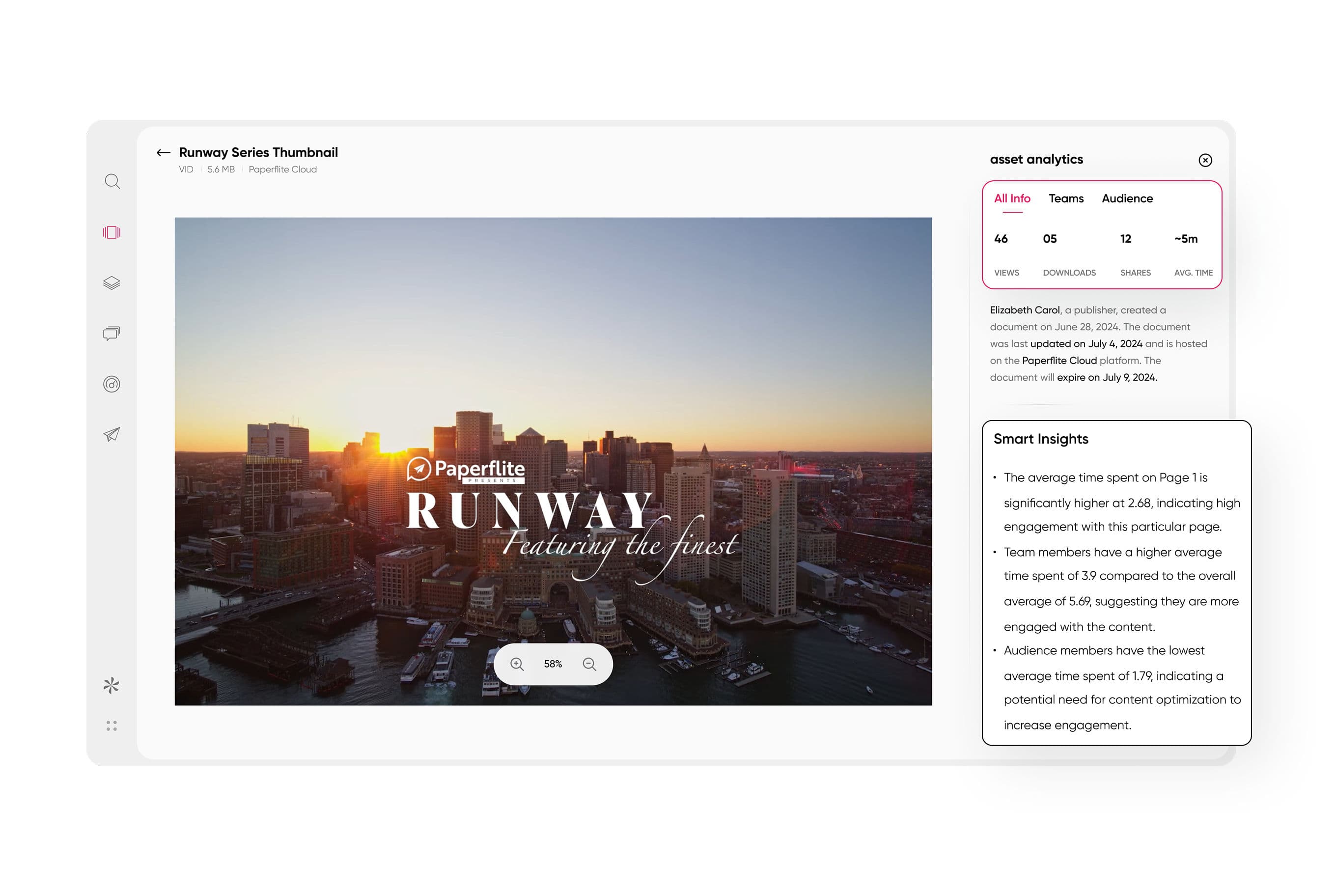
Per-asset engagement at recipient level, which is the depth the analytics question is actually testing for.
What should disqualify a vendor, including us
Here is the part a vendor guide usually leaves out. Six answers that should end an evaluation, and they apply to pf1 exactly as they apply to anyone else.
- They will not run the pilot on your content. If a vendor needs their own library to look good, you have learned what you needed to.
- Metadata is optional and they describe that as flexibility. It is not flexibility. It is a field that will be empty in three months.
- They cannot show you an export. A described export is not an export. Ask for the file.
- AI scope is vague. "It uses your content" is not an answer to which content. If they cannot tell you what the AI can and cannot reach, nobody can govern it.
- The admin burden has no number attached. Every platform in this category needs ongoing maintenance. A vendor who says otherwise either does not know or is not saying.
- Your top-ranked problem is their weakest third. This is the one most likely to apply to us, and it is the reason to rank the three products before shortlisting rather than after.
That last one deserves the honest version. If what you need most is training, certification and coaching at scale, we are not the strongest answer and a readiness-first platform will serve you better. Pretending otherwise would waste a quarter of your time and ours.
The related question of what a sales AI agent should do without approval belongs in the same conversation, because a vendor who cannot answer it precisely has not thought about governance as carefully as their AI messaging suggests.
Where pf1 fits in your revenue enablement needs
pf1, from the house of Paperflite, is strongest on the content and deal-execution thirds: governed content with compulsory metadata, buyer-side engagement at recipient level, and agents that act on that material rather than just retrieve it. The grounding argument is the one we would want tested in a pilot, because an agent working from an ungoverned library produces confident output on the wrong document, and that is a failure mode worth seeing before you buy rather than after.
See it for yourself, book a demo
The question to open the next call with
Skip the feature walkthrough. Open with the ninth criterion, the export, because it is the one question whose answer cannot be improvised and whose answer tells you how the rest of the evaluation will go.
Then ask for the pilot on your own content. If both answers come back clean, you are talking to a vendor worth spending a quarter on. If either one turns into a conversation about roadmap, you have saved yourself the quarter.
Score us on the same sheet as everyone else
The vendor scorecard turns all nine criteria into a sheet you can score a shortlist against, with the disqualifying answers listed beside each one, and we are happy to be scored on it alongside everyone else when you book a demo.
FAQ
How do you evaluate revenue enablement software?
Start by deciding which of three products you are buying: content management, training and readiness, or deal execution. Rank them in order rather than treating all three as equally important. Then test nine criteria through specific questions rather than a feature checklist, and run a pilot on your own content instead of relying on a demo environment.
What are the most important criteria for a revenue enablement platform?
Content governance, the metadata model, permissions granularity, search and retrieval, buyer-side engagement data, CRM write-back, AI grounding and governance, admin burden, and data export. The metadata model matters more than its position suggests, because if fields are optional they end up empty and everything downstream degrades.
Should you run a pilot before buying enablement software?
Yes, and it should run on your own content rather than the vendor's. A demo library is clean, deduplicated and fully tagged, which is the one condition in which every platform performs well. Load a difficult slice of real content, have untrained reps try to find something, send one real asset to one real buyer, and get the setup time from your admin rather than the vendor.
What questions should you ask about CRM integration?
Which objects and fields the platform writes to, who owns the field mapping, and what happens when a write fails. “We integrate with Salesforce” is true of every vendor in the category and tells you nothing. Also ask how users are provisioned and deprovisioned through your identity provider, and where the data is stored.
How can you tell if a vendor's engagement analytics are useful?
Ask to see one real recipient's engagement on one real asset, with everything captured. Useful analytics are per recipient and per asset with time spent and sequence, so you can distinguish a nine-second glance from a careful read that got forwarded. Totals for views, downloads and shares are reporting rather than signal.
What should disqualify a revenue enablement vendor?
Refusing to pilot on your content, describing optional metadata as flexibility, being unable to produce an actual export file, vague answers about what their AI can reach, no number attached to ongoing admin burden, and being weakest at whatever you ranked as your most important problem. That last one is the most common and the easiest to spot early.
Is there an independent evaluation of revenue enablement platforms?
The most cited non-vendor evaluation is Forrester's Wave on revenue enablement platforms from the third quarter of 2024. It is worth knowing it exists, and worth noting that it is two years old, so it predates most of the agent-related capability now being sold in this category. Everything else on the first page of search results is vendor-authored.
Paperflite's Content Technologyin Action
It's Easier Than Falling Off a Log
(Don't Ask Us How We Know That)

